When someone tells you, “Your will has to be recorded,” that statement can provoke anxiety: Is it something you neglected? Will you lose control of your legacy? As local lawyers for wills based in Richmond, Virginia, we at PJI Law see these concerns often. The answer is nuanced—and important. In Virginia, a will typically becomes part of the public record only once it is admitted to probate and then recorded by the clerk. But many people wonder: Does a will have to be recorded in Virginia? That depends on factors like whether probate is required, whether real property is involved, how the will is proved, and whether someone wants public notice of devise.
These choices can feel overwhelming—especially when family members, minor children, second marriages, or complex assets are involved. Below, as Virginia estate planning attorneys, we will explain how “recording a will” works (and when it’s necessary), how the probate process interacts with recording, and how a wills lawyer can guide you to peace and legal clarity. Then we can guide you regarding your specific needs according to your situation during your consultation.
Overview of Virginia Wills, Probate, and Recording
Key Terms and Concepts
Before diving into the central question, let’s clarify some foundational concepts:
- Legally valid will: In Virginia, a will must be in writing, signed by the testator (or someone acting at his direction), and witnessed by two competent witnesses (or, in limited cases, wholly handwritten with sufficient proof).
- Self-proving wills: A common practice is to attach a notarized affidavit (signed by testator and witnesses under oath) so that, at death, the court can accept the will without contacting witnesses.
- Probate process: Probate is the formal process of proving a will before the circuit court in the decedent’s jurisdiction, qualifying a personal representative (executor or administrator), collecting assets, settling debts/taxes, and distributing the remaining estate.
- Recording a will: Once admitted to probate, the clerk records the will or an authenticated copy in the clerk’s office (often in a “will book”) so it becomes part of the public record.
- Devise: In Virginia estate law, a devise is a gift of real property—such as land or a home—made through a will, with the recipient called the devisee. While Virginia Code § 64.2-100 now defines “devise” broadly to include both real and personal property, the term is still commonly used to distinguish gifts of real estate from a bequest, which refers to personal property like money or belongings.
Thus, a will cannot simply be recorded while the testator lives; it is only recorded as part of probate. That is the crux of the answer to “Does a will have to be recorded in Virginia?” for the majority of practical purposes. The facts of your situation will determine the answer for your specific circumstances. 
The Conditions Affecting When a Will Has to Be Recorded in Virginia
A will has to be recorded in Virginia only after its admission to probate. The will does not need to be recorded while the testator is alive, nor does every scenario require that recording (for example, when no real property is involved or no public notice is needed beyond the local court). The operative phrase from the statute is “every will or authenticated copy admitted to probate … shall be recorded.”
Below, we break down circumstances and exceptions to help clarify where the requirement applies and where it might not.
Scenarios When Recording a Will Is Required
In Virginia, a will needs to be recorded under the following circumstances:
- When the decedent owned real property or real estate interests: If the testator owned real property and devised it, the personal representative must make sure that certified copies of the will are recorded in the county or city where such real estate is located. That gives public notice of the devise to third parties (e.g., prospective purchasers).
- Interests in multiple localities: If real property is located in more than one jurisdiction, the will (or certified copy) must be recorded in each relevant locality to appropriately memorialize the devise.
- Statutory protection for bona fide purchasers: Recording within one year of death is essential to preserve the devise against bona fide purchasers without notice. If a purchaser acquires land without knowledge of the devise and the will is not recorded in time, the devise may not affect that purchaser’s title. § 64.2-456 addresses this protection.
Situations Where Recording a Will Is Not (or Less Likely to Be) Required
The following are exceptions in which it is not necessary to record a will in Virginia:
- No real property involved: If the decedent only held personal property (bank accounts, stocks, personal possessions, etc.) and nothing required probate beyond perhaps small distributions, the need to record in remote jurisdictions is moot. The will must still be admitted and recorded in the local court, but additional recordings in remote counties may not be necessary.
- No probate (small or insolvent estates): In certain small estates or estates whose entire assets pass outside probate (e.g., via payable-on-death designations, joint accounts with rights of survivorship, or trusts), the will may never be presented to probate at all. In such cases, there is no admission and thus no recording requirement.
- Testator dies without a will (intestate): If someone dies intestate (without a valid will), then no will is admitted in the first place, and nothing is recorded as a will. The estate administration proceeds under intestacy statutes.
Thus, the practical effect is that a will is recorded only when necessary in relation to probate and real property. That means the question “Does a will have to be recorded in Virginia?” is more accurately answered: “It must be recorded after probate, when required by statute, especially if real property is concerned.” 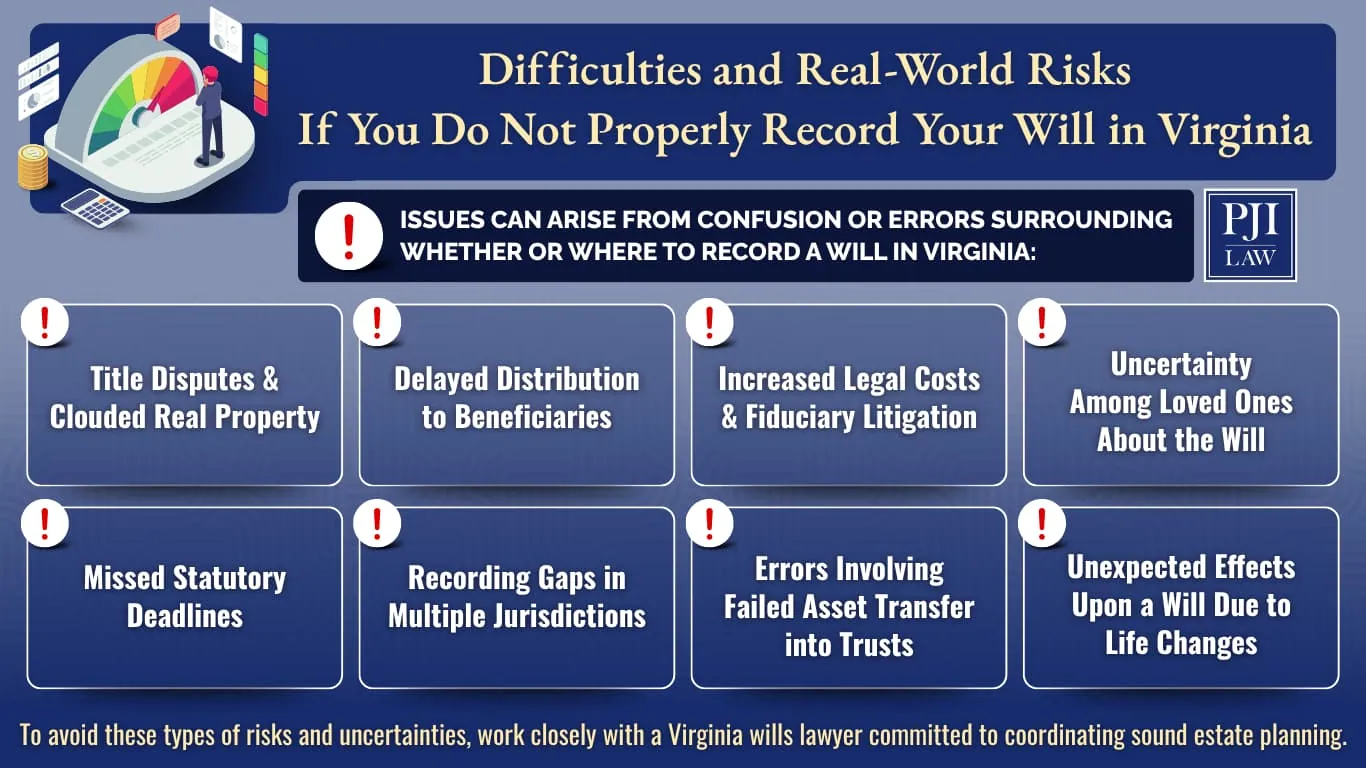
Associated Difficulties and Real-World Risks If You Do Not Properly Record Your Will in Virginia
It’s not enough to know whether recording is technically required. Many of the issues people fear, such as family disputes, hidden claims, and defective titles, stem from missteps about whether and where to record.
The following are some of the common issues we see as local lawyers for wills in Virginia:
- Title disputes and clouded real property: If a will is not recorded in the proper county, a purchaser or mortgage lender might not see the devise. Later, heirs or devisees may dispute ownership, leading to costly litigation or demands to reverse transactions.
- Delayed distribution to beneficiaries: When probate is contested because the will wasn’t properly proved or recorded, the executor can’t move forward with distributing assets, leaving family members in limbo, especially in second marriage or blended family cases.
- Increased legal costs and fiduciary litigation: Fiduciary litigation may arise when heirs accuse the personal representative of failing to record or assert rights. That leads to contested litigation over the validity of the will or accounting.
- Confusion among loved ones: Especially when minor children are involved, failure to properly record or publicize the will may lead to uncertainty about guardianships, inheritance rights, or delayed support to children and spouse.
- Missed statutory deadlines: The one-year deadline to record a will for protection against bona fide purchasers is absolute under § 64.2-456; missing that window can forfeit a devise.
- Multiple jurisdictions and decentralization: If the decedent’s property spans Chesterfield County, Henrico County, Fairfax County, or elsewhere, failing to record in all required localities leaves gaps.
- Trusts and revocable living trusts interplay: Some clients believe that placing assets in a revocable living trust entirely removes the need for recording or probate, but real property not transferred into the trust may still require will admission and recording. Coordination is essential.
- Changing life circumstances: After divorce, remarriage, or business changes, a will must be updated or revoked. If a legacy devise to a former spouse remains but is not recorded properly in line with current statute, confusion arises.
These concerns reinforce why clients should work with a local attorney versed in Northern Virginia’s realities. A skilled Virginia estate planning attorney can help you design documents that reduce the need for probate, coordinate multiple jurisdictions, and guide your executor in properly recording wills where needed.
Q&A: Important Considerations Regarding Recording a Will in Virginia
Below are frequently asked questions regarding recording a will in Virginia, along with concise answers.
Q: If I live in Richmond but have property in another county, do I need to record the will there, too?
Yes. Under Virginia Code § 64.2-455, the personal representative must record a certified copy of the will in any locality where the decedent owned real property or where the will disposes of real estate.
Failure to do so may prevent devise claims from being enforceable against third parties without notice.
Q: Can I bring my will to the circuit court and have it recorded now, before my death?
No. A will must first be admitted to probate before it can be recorded. The clerk’s role to record exists only after the court authenticates the will via probate. Until then, your will remains a private document.
Q: Must I use a self-proving will to simplify recording?
While not strictly required, a self-proving will greatly simplifies the probate and recording process. If a will includes a notarial affidavit, the court may admit it without having to locate witnesses to testify. That reduces delays and costs. If the will is not self-proving, one or more witnesses may have to appear or provide a deposition.
Q: What happens if the will is not recorded within one year of probate?
Under § 64.2-456, a bona fide purchaser without notice may avoid the devise if the will is not admitted and recorded within one year after death. That means the purchaser may take title free of the devise, leaving the intended beneficiary with no enforceable claim.
Q: Does the recording requirement apply to trusts or revocable living trusts?
Not directly. The statutory requirement to record arises only for wills admitted to probate. If assets are entirely within a revocable living trust, the will may not be probated at all. But if you fail to fund the trust with real property and leave residual property under your will, that will still need admission and recording. Be sure to coordinate will and trust together.
Q: Must I record documents like advance medical directives, a living will, durable power, or health care directives?
No. Those sensitive documents are typically kept private and do not go through probate or recording in the public record. They operate during life (for incapacity) rather than at death.
Q: Can someone contest the will during the recording step?
Yes. Any interested party may appeal the clerk’s probate decision (including admission or denial) within six months of the order. That is part of Virginia’s probate proceedings structure. If contested, the recording could be delayed until resolution.
Q: What if the will is handwritten (holographic)? Do special recording rules apply?
Virginia does allow wholly handwritten wills under certain strict proof rules. But even if admitted, they must be recorded like any other will. Proof standards are more demanding (proving handwriting, intent, etc.).
Q: How do I find a local attorney for wills who understands Northern Virginia’s courts?
Seek a Virginia estate planning attorney in Richmond or surrounding counties with experience in trusts, estate administration, and probate in Richmond, Arlington, Loudoun, Prince William, Henrico, Chesterfield, and Fairfax. Interview prospective attorneys about their experience in wills, probate procedures, and recording practices. Local lawyers for wills will understand the particular rules and clerk procedures in each jurisdiction. 
When and How Wills Are Recorded in Virginia
The type of will and other circumstances come into play when determining when and how wills need to be recorded in Richmond, Virginia.
Statutory Requirement: Virginia Code § 64.2-455
Virginia law is clear that, once a will is admitted to probate (or an authenticated copy is so admitted), it must be recorded by the clerk of the circuit court and remain in the clerk’s office (except under limited circumstances).
The statute further provides:
“Every will or authenticated copy admitted to probate by any circuit court or clerk … shall be recorded by the clerk and remain in the clerk’s office … A certified copy … may be recorded in any county or city wherein there is any estate, real or personal, devised or bequeathed by such will.”
Further, subsection (B) requires the personal representative to cause a certified copy of the will to be recorded in any locality (county or city) where real property of the decedent is located or is being devised.
Once recorded, the will (or certified copy) operates as public notice of the devisees’ interest in real property in that jurisdiction.
So, for estates involving real property, the recording requirement serves as constructive notice to third parties (e.g., potential purchasers) of claims under the will.
Virginia also protects bona fide purchasers without notice of a devise; unless the will (or certified copy) is admitted to probate and recorded within one year of death, such purchasers may be shielded from certain claims. § 64.2-456 of the Virginia Code addresses this scenario.
Probate and Recording: The Practical Sequence
As we explain below, a will in Virginia must be recorded once it is admitted to probate:
- Filing the Will for Probate: The person (often the designated executor) presents the original will and death certificate to the circuit court in the jurisdiction where the decedent resided (or where real property is located) to qualify as personal representative and admit the will.
- Proof of the Will: The requirements differ by the type of will:
- For a self-proving will, the attached notarized affidavit suffices, and the court will typically admit it without contacting witnesses.
- For a will without the self-proving affidavit, one of the witnesses (or both) must often be summoned to testify or give a notarized statement about execution.
- For purely handwritten (holographic) wills, proof must show that the entire document is in the testator’s handwriting and that the testator intended it as a will, with testimony from at least two disinterested witnesses (unless older statutes apply).
- Clerk Admits and Records the Will: Once admitted, the clerk records the will or an authenticated certified copy in the will book of the clerk’s office (i.e., the permanent public record). The recorder indexes it, typically by grantor (testator) name, so anyone searching the deed or will indices may locate it.
- Recording Copies Where Real Property Lies: If the decedent held real property in multiple counties or cities, the personal representative must cause certified copies of the will to be recorded in those jurisdictions so that devisees’ interests in local real estate are publicly noted.
- Public Notice and Effect: Upon recording, any purchaser or third party is on notice of the devise in that jurisdiction. That serves to protect devisees and prevents later disputes over ownership of real property.
Thus, by statute, once a will is admitted to probate, it must be recorded — but only after that admission, not before. In other words, a living testator (person yet alive) cannot record their will in the clerk’s office in advance, as the clerk’s authority to record arises only by the act of probate. 
How an Estate Planning Attorney Helps with Recording and Avoiding Problems in Richmond, Virginia
Working with a Virginia estate planning attorney yields several advantages:
- Strategic drafting: A good wills lawyer makes sure your will is legally valid, includes a self-proving affidavit, coordinates properly with trusts, and addresses life changes (e.g., second marriages, divorce, children, minor children, co-owner of real property).
- Clerk and circuit court coordination: Local attorneys know the particular rules and deadlines of Richmond, Henrico, Chesterfield, or Fairfax courts. They help to manage the correct submission of the original will, required forms, affidavits, and indexing.
- Assisting executors: After your death, your attorney can guide your executor through the probate process, handling proof of wills, recording, preparing inventory and accounting, and liaising with the Commissioner of Accounts.
- Multi-jurisdictional property: For clients with real property across counties (or in Richmond, Chesterfield, Henrico), the attorney plans how to record in each needed locality, protecting devise rights across jurisdictions.
- Conflict prevention and fiduciary protection: A well-drafted will reduces ambiguity and decreases the risk of future fiduciary litigation. If disputes do arise, the attorney can help defend the estate and represent fiduciaries or beneficiaries.
- Probate avoidance strategies: The attorney helps you use trusts, joint ownership, beneficiary designations, and other techniques to reduce the need for probate and minimize public exposure.
- Updates over time: As life changes occur (marriage, second marriages, births, divorces, business interests), you’ll need to revise your plan so that your will’s provisions remain aligned with your wishes and the law.
What Happens in Richmond, Virginia
To give you a more concrete sense, here’s how the process typically plays out in Richmond, Virginia:
After death, the named executor contacts a local lawyer and the Richmond Circuit Court Clerk’s Office, submits the original will and a certified death certificate, and applies for probate. The application is made in the city where the decedent resided at the time of death. In this case, it is the City of Richmond. If the decedent lived outside the city but owned real property in Richmond, probate can alternatively be initiated in the jurisdiction where the property lies.
If the will is self-proving, the clerk or court can usually admit it to probate without requiring witnesses to appear. If it is not self-proving, one or more of the witnesses who signed the will may need to provide an affidavit or appear before the clerk or judge to verify that the will was properly executed. Once the will is admitted to probate, the Richmond Circuit Court Clerk records it in the will book maintained in the clerk’s office and indexes it under the testator’s name. This step makes the will a matter of public record, as required by Virginia Code § 64.2-455.
If the decedent owned real property in other localities—for example, in Henrico County, Chesterfield County, or elsewhere in Virginia–then the executor must secure a certified copy of the recorded will from Richmond and record that copy in each locality where real estate is located. This serves as public notice of the devise and helps protect the interests of the beneficiaries.
After probate, the executor must complete the next stages of estate administration: preparing and filing an inventory of the estate, notifying heirs and beneficiaries, paying any outstanding debts and taxes, and submitting required accountings to the Commissioner of Accounts assigned by the Richmond Circuit Court. The Commissioner of Accounts reviews and approves each filing to verify that the executor is handling all assets, funds, and distributions appropriately.
When all debts, taxes, and distributions are finalized, the executor files a final accounting with the Commissioner of Accounts, and the estate is closed.
The advantage of working with a local attorney for wills familiar with Richmond’s Circuit Court is that they understand the city’s probate appointment procedures, required forms, and communication process with the Commissioner of Accounts. A Richmond wills lawyer helps keep the process organized, timely, and compliant with Virginia’s estate administration laws, including proper recording of wills in the necessary jurisdictions.
Practical Tips for Clients and Families
- Always keep the original will in a safe but accessible place (e.g., in the possession of a trusted person or law firm). The probate clerk will not accept copies.
- Attach a self-proving affidavit at execution to avoid the hassle of locating witnesses later.
- Inform your executor about the location of the will, your goals, and whether you own property in multiple counties.
- After the testator’s death, communicate early with an attorney so that the executor can follow proper steps: file for probate in time, record the will, schedule filings to the Commissioner of Accounts, and meet account deadlines.
- Update your will after major life events (e.g., divorce, second marriages, births) to keep it properly drafted and to avoid unintended consequences.
- Ask your attorney to map out a recording plan for jurisdictions where you own real estate (Richmond, Henrico, Chesterfield, Fairfax, etc.).
- Make sure the executor understands the timeline for recording. The one-year statute for protecting devise rights under § 64.2-456 is firm.
Schedule a Consultation with PJI in Richmond, Virginia
To sum up the answer to the question of whether a will has to be recorded in Virginia, the answer is yes — but only after it is admitted to probate, and the requirement is most meaningful when real property is involved. A will is not recorded while the testator lives. The statute compels recording by the clerk of any will admitted to probate, and certified copies must be recorded where real estate lies. Failing to record on time can jeopardize the enforceability of devises, especially with bona fide purchasers.
Because of these technical rules and jurisdictional quirks, working with a local attorney for wills is wise. The attorney makes sure your will is properly drafted, self-proving, coordinated with trusts or powers, and that your executor follows each of the required steps to record in the correct localities. With proper guidance, you reduce the risks of title disputes, fiduciary litigation, and delays in distributing assets to your loved ones.
If you are in Richmond or Northern Virginia and you want a free consultation to discuss your will, trust, or estate plan, contact PJI Law. Call us at (804) 653-3450 or complete our online form to schedule your consultation today. Our team of local lawyers for wills stands ready to assist you with estate administration, probate questions, recording matters, and long-term planning to protect your legacy and provide peace to your loved ones.
Copyright © 2025. PJI Law, PLC. All rights reserved.
Copyright © 2026. PJI Law, PLC. All rights reserved.
The information in this blog post (“post”) is provided for general informational purposes only and may not reflect the current law in your jurisdiction. No information in this post should be construed as legal advice from the individual author or the law firm, nor is it intended to be a substitute for legal counsel on any subject matter. No reader of this post should act or refrain from acting based on any information included in or accessible through this post without seeking the appropriate legal or other professional advice on the particular facts and circumstances at issue from a lawyer licensed in the recipient’s state, country, or other appropriate licensing jurisdiction.
3900 Jermantown Road, 2nd Floor
Fairfax, VA 22030
(703) 546-9674
https://www.pjilaw.com
Request A Complimentary Call From Our Team
Provide your details, and we’ll reach out promptly to assist you.