
Faced with life’s uncertainties, many people in Richmond, Virginia, wisely seek the services of a lawyer to prepare the appropriate legal documents to protect themselves and their loved ones. A power of attorney (POA), a legal arrangement that grants someone you trust the authority to act on your behalf in specific circumstances or when you cannot make your own decisions, remains one of the most critical tools for planning.
Virginia residents can create a general power of attorney and durable power of attorney. But what does each one do?
This blog, from a knowledgeable Richmond lawyer, explores the fundamental differences between these POAs, their uses, and when they might be suitable, based on each person's unique circumstances and goals. We’ll also highlight the importance of consulting an experienced lawyer to tailor these documents to fulfill your goals and comply with Virginia law. 
What Is a Power of Attorney?
A power of attorney is a legal document that allows an individual (the principal) to appoint someone else (the agent or attorney-in-fact) to make decisions or act on their behalf. The scope and duration of the agent’s or attorney-in-fact's authority depends on the type of POA and the instructions it contains.
For residents in and around Richmond, Virginia, a POA can simplify handling personal, financial, and even legal matters during times when the principal cannot handle them. However, the terms of POA documents can vary.
General Power of Attorney
A general power of attorney (GPOA) grants broad authority to the agent to handle various tasks on behalf of the principal, which can include managing financial matters, conducting business operations, signing agreements, or purchasing property.
Features of a General Power of Attorney
- Scope of Authority: The agent can perform numerous actions as outlined in the document, from paying bills and managing investments to conducting real estate transactions.
- Timeframe: Typically, a general power of attorney remains valid only as long as the principal retains the mental capacity to make decisions. If the principal becomes incapacitated, whether due to illness, injury, or other reasons, a GPOA automatically terminates.
- Purpose: Virginia residents often use this arrangement for short-term needs, such as when the principal is traveling or temporarily unable to handle their affairs due to circumstances like military deployment.
Example Scenario for a General Power of Attorney
Imagine Ben, a Richmond resident, is leaving for an extended work assignment overseas. Worried he’ll be unable to manage his financial transactions while abroad, he executes a GPOA that allows his trusted friend to oversee his banking and pay his bills. However, if Ben were to become incapacitated, it would render the document invalid, leaving his affairs unmanageable without further legal action. 
Durable Power of Attorney
By contrast, a durable power of attorney (DPOA) remains effective even if the principal becomes incapacitated, making it a critical tool in estate planning and long-term personal care planning.
Features of a Durable Power of Attorney
- Lasting Authority: A DPOA remains in effect if the principal becomes unable to manage their own affairs due to mental or physical incapacity.
- Broad Applications: Much like a GPOA, a DPOA can authorize the agent to undertake an array of financial, legal, and personal tasks.
- Health Care Provisions: Durable POAs often manage medical decisions when used in conjunction with a health care POA or advance medical directive.
- Customizable Options: With the help of an attorney, a Virginia resident can tailor the document to include specific instructions, such as which powers the agent can exercise and under what conditions.
Example Scenario for a Durable Power of Attorney
Consider Sarah, a retired Richmond teacher, concerned about future health issues that could make it impossible for her to manage her finances. With the help of her attorney, she sets up a DPOA granting her daughter authority to pay bills, manage investments, and even make healthcare-related decisions. If Sarah develops dementia or another incapacitating condition, the DPOA keeps her daughter’s authority to act on her behalf intact, avoiding costly legal delays.
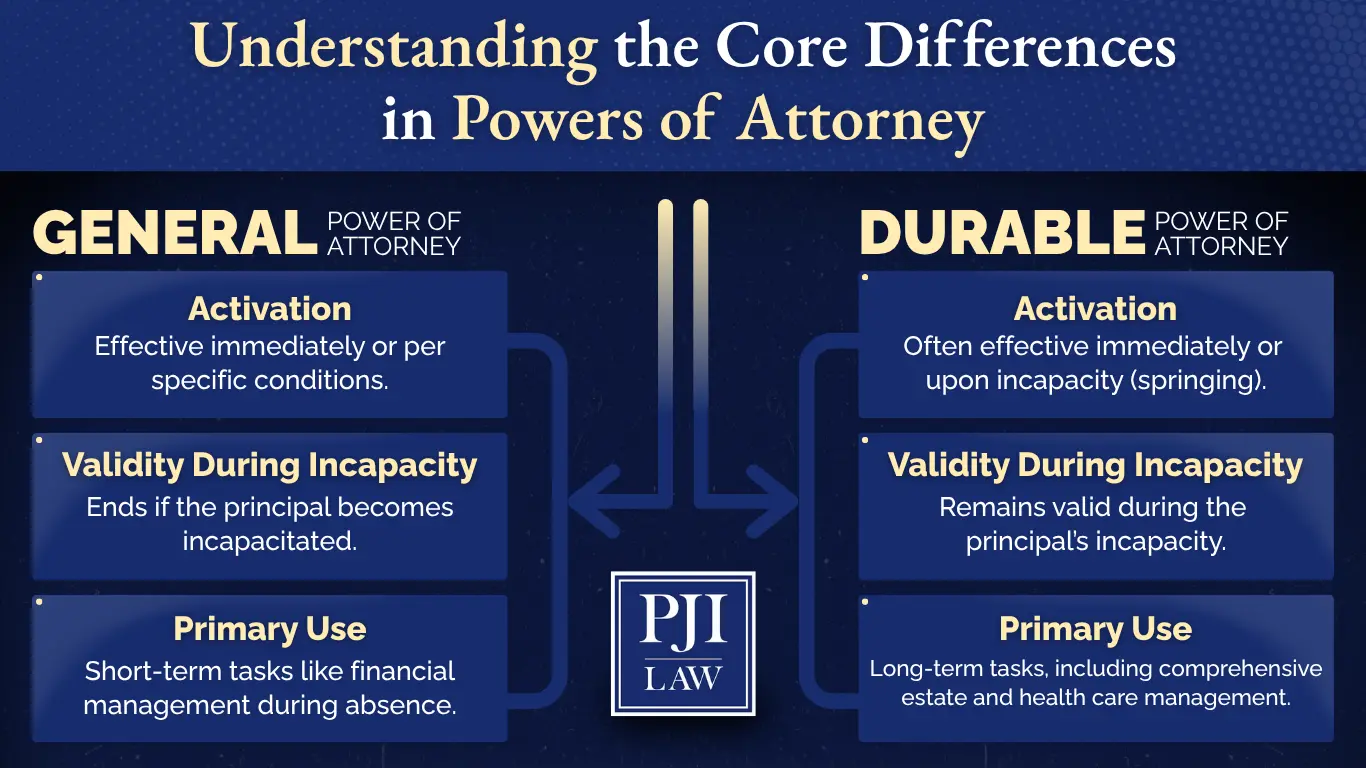
Understanding the Core Differences
Although the General POA and Durable POA authorize an agent to handle certain duties for the principal, their most significant difference lies in when the authority ends.
Feature
General Power of Attorney
Durable Power of Attorney
Activation
Effective immediately or per specific conditions.
Often effective immediately or upon incapacity (springing).
Validity During Incapacity
Ends if the principal becomes incapacitated.
Remains valid during the principal’s incapacity.
Primary Use
Short-term tasks like financial management during absence.
Long-term tasks including comprehensive estate and health care management.
When Should You Use Each Type of POA?
Deciding which POA suits you depends on your individual circumstances and goals.
Choose a General POA When:
- You need short-term help with financial or legal matters due to travel, military deployment, or other temporary unavailability.
- You’re entirely confident in your ability to actively oversee the tasks being handled by your agent.
- Incapacity concerns are not an issue, or you plan to revoke the POA before they arise.
Create a Durable POA When:
- You want a comprehensive, long-term solution to meet your legal, financial, and personal needs.
- You’re planning for the possibility of incapacitation due to aging, medical issues, or unexpected accidents.
- Your estate plan prioritizes continuity and seeks to avoid court intervention through guardianship or conservatorship.
Tailoring a POA for Your Needs
Because POA documents grant significant authority over your affairs, you want to tailor them specifically to your circumstances.
How PJI Law Can Help
At PJI Law, our team focuses on establishing legally sound and personalized POA documents by:
- Listening to Your Needs: We take the time to understand your unique goals, family dynamics, and concerns.
- Offering Tailored Guidance: Based on your situation, we help determine whether a General POA, Durable POA, or both are right for you.
- Complying with Virginia Laws: Your documents will fulfill every necessary standard, due to our in-depth knowledge of Virginia’s legal requirements.
- Providing Ongoing Support: Life is unpredictable, and circumstances change. We’re here to update or adjust your POA documents as your needs evolve.
Frequently Asked Questions About Virginia POAs
What is the main difference between a General and Durable Power of Attorney?
The main difference is how the two documents operate if the principal becomes incapacitated. A general power of attorney ends if the principal is no longer mentally competent, while a durable power of attorney remains in effect, allowing the agent to continue managing the principal’s financial affairs or healthcare decisions.
What does a Durable Power of Attorney typically handle?
A durable power of attorney can include financial powers such as managing bank accounts, handling bills, or overseeing investments. When coupled with an Advanced Medical Directive, your agent can be vested with medical powers, enabling them to make healthcare decisions on behalf of the principal if they cannot communicate their wishes.
When does a Power of Attorney document take effect?
Virginia residents can structure a POA to take effect immediately upon signing or to become active upon a future event, such as the principal’s incapacitation. For instance, a “springing” POA takes effect only when the principal is deemed incapacitated, as specified in the document.
Can I customize the powers granted in the POA?
You can assign specific powers to your agent, whether for financial matters, healthcare decisions, or both. Working with an estate planning attorney aligns these powers with your wishes and complies with Virginia law.
What is a successor agent?
A successor agent is an individual designated in a POA document to step in if the primary agent is unable or unwilling to perform their duties to maintain continuity in your financial affairs, healthcare decisions, or other matters according to your wishes. Assigning a successor agent adds an extra layer of security and continuity, preventing disruptions if the original agent cannot serve.
How do I get financial institutions to honor my POA?
You should keep the original POA document in a safe place and provide certified copies to the relevant parties. Because banks or other institutions may require specific verifications, it's wise to consult an estate planning attorney for assistance.
What should I consider when choosing an agent for my POA?
Choose a trustworthy individual who understands your goals and wishes. For financial powers, the agent should have strong organizational skills and financial knowledge. For medical powers, select someone capable of advocating for your healthcare preferences during stressful situations.
Can I revoke or amend my Power of Attorney?
Yes, as long as you are mentally competent, you can revoke or amend your POA at any time. It’s important to notify all relevant parties, including financial institutions, of the change and establish proper documentation.
Should everyone have both types of POA?
Not necessarily. Whether you need a general, durable, or both types of POA depends on your specific circumstances. Consulting an estate planning attorney can help you determine the right options based on your financial affairs, health concerns, and overall goals.
Why is it important to work with an estate planning attorney for a POA?
An estate planning attorney will create a POA that complies with Virginia law, protects your interests, and clearly outlines specific powers for your agent, reducing the risk of disputes, mismanagement, or invalidation of the document. 
Contact PJI Law in Richmond to Create Your Virginia Power of Attorney
Life is full of surprises. Preparing for a future date when you could become incapacitated or otherwise unable to handle your business, healthcare, or personal affairs protects you and your loved ones. Have you been typing “estate planning lawyer near me,” “POA in Virginia,” or “Virginia power of attorney” into your search bar?
Whether you need a general power of attorney for short-term matters or a durable power of attorney for comprehensive and long-term security, a knowledgeable lawyer from PJI Law will explain your options, prepare the proper power of attorney form in compliance with Virginia law, and give you peace of mind. Contact PJI Law today at (804) 653-3450 or complete our online form to schedule a free consultation and receive personalized service and attention.
Copyright © 2025. PJI Law, PLC. All rights reserved.
Copyright © 2026. PJI Law, PLC. All rights reserved.
The information in this blog post (“post”) is provided for general informational purposes only and may not reflect the current law in your jurisdiction. No information in this post should be construed as legal advice from the individual author or the law firm, nor is it intended to be a substitute for legal counsel on any subject matter. No reader of this post should act or refrain from acting based on any information included in or accessible through this post without seeking the appropriate legal or other professional advice on the particular facts and circumstances at issue from a lawyer licensed in the recipient’s state, country, or other appropriate licensing jurisdiction.
3900 Jermantown Road, 2nd Floor
Fairfax, VA 22030
(703) 546-9674
https://www.pjilaw.com
Request A Complimentary Call From Our Team
Provide your details, and we’ll reach out promptly to assist you.