Your family doesn’t fit into a single category anymore. You have a new spouse, children from a prior marriage, maybe stepchildren you care deeply about, and financial responsibilities that don't fit into a simple box. You want to protect each person. You want your wishes followed. And you don't want your family dealing with conflict after you're gone.
But when it comes to estate planning for blended families, things don't always work the way people expect. In Virginia, the way assets pass after death can create real problems if your plan isn't structured carefully. A surviving spouse might receive more than you intended. Children from a previous marriage may be unintentionally left out. Beneficiary designations can override your will entirely. That's why estate planning for blended families takes more than a basic will. It requires a clear strategy that reflects your relationships, your priorities, and your long-term goals.
This blog covers how estate planning works for blended families in Virginia, what risks to watch for, and how to build a proper estate plan that protects the people who matter most to you.
At a Glance
- Blended families face unique challenges in estate planning when balancing a spouse and children from a prior relationship.
- In Virginia, a surviving spouse may have rights that override parts of your plan.
- Under Virginia intestate succession laws, stepchildren and stepparents do not automatically inherit unless legally adopted or specifically named.
- Beneficiary designations and joint ownership often control how assets pass, regardless of your will.
- A revocable living trust can help control distribution and reduce conflict.
- Without proper planning, potential conflicts between family members are common.
- Working with an estate planning attorney in Richmond, VA can help you structure a plan that reflects your unique situation.
What Estate Planning Looks Like for Blended Families in Virginia
When you're part of a blended family, your estate plan has to do more than distribute assets. It has to manage relationships, expectations, and estate planning challenges that don't arise in a traditional family structure.
Unlike a first marriage where both spouses share the same children, blended families often involve:
- Children from a prior marriage or prior relationship
- A new spouse with their own children
- Shared assets and separate property
- Different financial priorities that don't align neatly
That combination creates unique challenges. You're not just deciding who receives your estate. You're deciding how to balance fairness, protect your children's inheritance, and support your spouse at the same time.
A strong plan considers what happens at your death, what happens after your spouse's death, and how assets are preserved or distributed over time. Without that level of detail, even a well-intentioned plan can fall apart. That's why estate planning for blended families requires careful attention and should never be approached with a one-size-fits-all document. 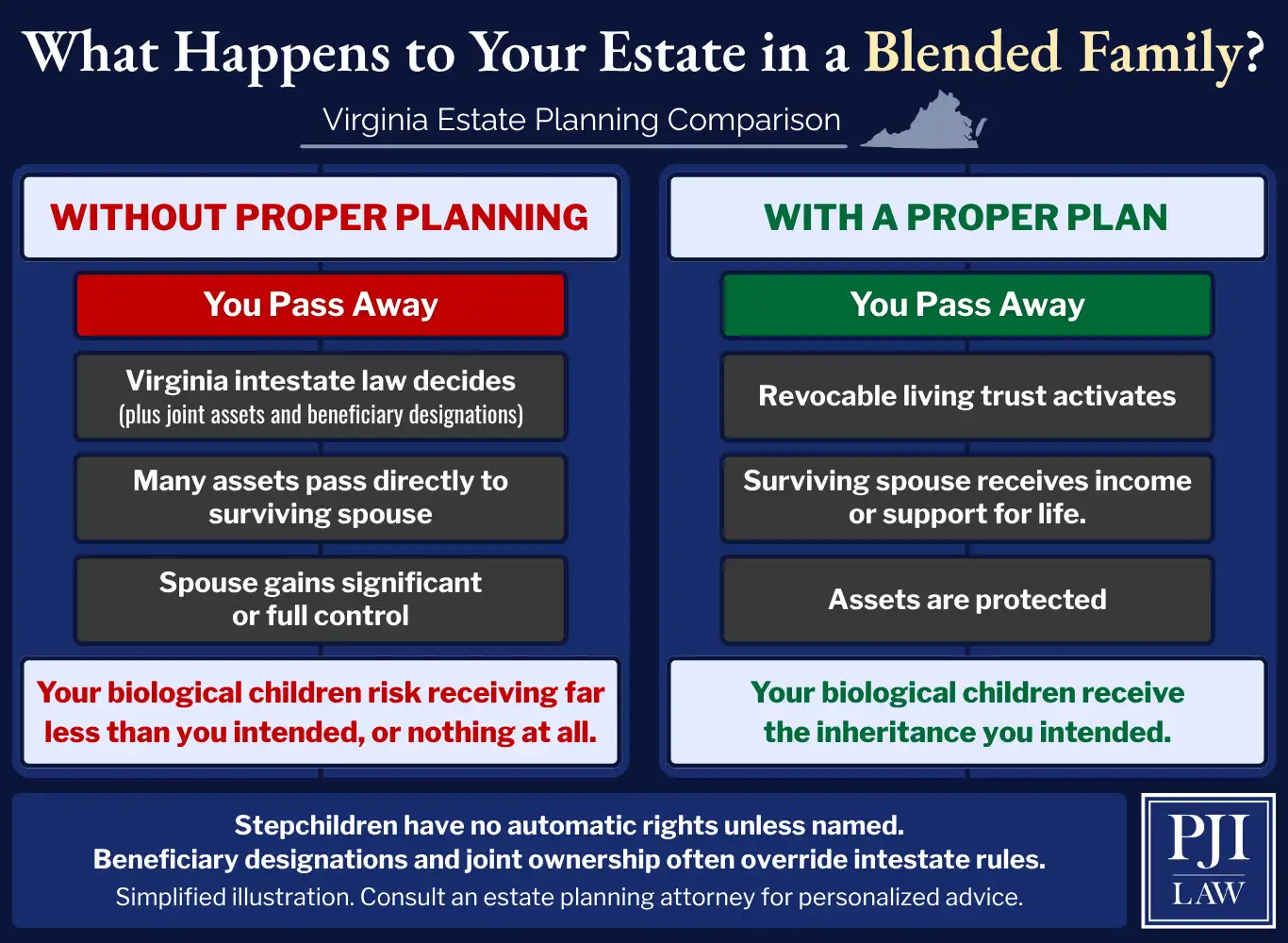
Why Blended Families Face Unique Legal Risks
The biggest issue isn't usually intent. It's structure. Many people assume that leaving everything to their spouse will "work itself out" later. But in blended families, that approach can create serious problems for both you and your children. These situations often arise after:
- A second marriage
- A divorce followed by remarriage
- A long-term partnership with shared financial obligations
The risk increases when:
- Estate planning documents are outdated
- Beneficiary designations don't match your current wishes
- No trust structure is in place
Without proper planning, your spouse may legally inherit everything and later leave it to their own children. Your biological children may receive nothing from your estate, even if that was never your intention. Disputes between family members, including adult children, stepchildren, and other family members tied to the family through a prior relationship, can lead to probate litigation that drains the estate and damages relationships.
This is where proper planning becomes so important. You're not just dividing assets. You're preventing conflict before it starts.
Who Inherits in a Blended Family Under Virginia Law
If you pass away without a plan, Virginia law decides what happens. Blended family inheritance rights in Virginia are governed by intestate succession laws, and the result may not reflect your intentions at all.
In general, a surviving spouse may inherit a significant portion, or in some cases all, of your estate depending on your family structure. Stepchildren and stepparents typically do not inherit unless legally adopted or specifically named in your estate planning documents. Here's where it gets complicated. If you have children from a prior relationship, Virginia law generally provides that your surviving spouse receives one-third of your estate, while your children receive the remaining two-thirds. But that doesn't mean your children will ultimately receive what you intended.
If everything passes to your spouse first, your children rely on your spouse to pass those assets along later. That doesn't always happen. In fact, this is a common source of conflict in estate administration, and one that proper planning can address before it becomes a problem for your loved ones. The role of a deceased parent's prior wishes can become a point of dispute in these cases, particularly when no trust or clear directive is in place. A biological parent who wants to protect their children from a prior relationship needs a plan that doesn't depend on a surviving spouse's goodwill. 
The Biggest Estate Planning Mistakes to Avoid
Blended families often run into the same issues. These are the mistakes that lead to disputes, confusion, and unintended distribution of assets.
Relying on a Will Alone
A will-based plan may not give you enough control. Assets passing through probate can be delayed, contested, or distributed differently than expected. For blended families, the probate process also exposes your estate plan to challenges from other family members who feel their interests weren't addressed.
Ignoring Beneficiary Designations
Retirement accounts and life insurance policies pass directly to the named beneficiary, not through your will. If those designations are outdated, your assets may go to the wrong person entirely.
Overusing Joint Ownership
Adding a spouse to accounts or property through joint ownership can cause those assets to pass automatically to them, even if that's not what you intended for your children. Once the surviving spouse owns those assets outright, your children from a prior relationship have no legal claim.
Failing to Update After Divorce or Remarriage
A plan created during your first marriage may not reflect your current situation at all. After divorce or remarriage, your estate planning documents need to change — not eventually, but right away.
Not Planning for Long-Term Care
Without addressing long-term care costs, your estate could be significantly reduced before it reaches your loved ones. This matters in blended families because it affects both your spouse's financial security and your children's inheritance.
How to Protect Children From a Prior Marriage
 A common concern in blended families is making sure your biological children are included in your estate plan. You also want to support your spouse and avoid placing family members in conflict with one another.
A common approach is to separate access from ownership. Instead of leaving everything outright to your spouse, you can structure your plan so your spouse would have access to assets during their lifetime and your biological children would receive the remaining assets after your spouse's death. This protects both sides of your family while honoring your wishes and removes the pressure on a surviving spouse to act on good intentions alone.
This structure is particularly valuable when children from a prior relationship are minors or young adults who can't advocate for themselves in estate administration.
Using a Trust to Control Asset Distribution
When it comes to trusts for blended families in Virginia, a revocable living trust is one of the most effective tools available, and it's a structure that estate planning attorneys serving Richmond-area clients recommend regularly for this type of unique situation.
Unlike a will, a trust allows you to control how and when assets are distributed. With a properly structured revocable living trust, you can:
- Provide income or support to your spouse during their lifetime
- Preserve remaining assets for your biological children
- Avoid probate and reduce delays in distribution
- Reduce the risk of disputes among other family members
For example, your trust can state that your spouse receives income from certain assets during their life and that after your spouse's death, those assets pass to your children. This structure creates accountability and reduces potential conflicts between family members without requiring anyone to rely on informal promises.
A trust also gives you flexibility to address:
- Minor children who need managed distributions over time
- Adult children with different financial circumstances
- Unequal distributions where your relationships and family circumstances call for them
- Specific financial goals tied to your property and long-term wishes
For Virginia families with complex family structures, a revocable living trust is often the single most important document in the entire estate plan. Without this type of structure, you lose control over where your assets go after your spouse's death, which is one of the most common breakdowns in blended family estate plans. 
How Virginia's Elective Share Can Affect Your Plan
Even with a strong estate plan, Virginia law gives a surviving spouse certain rights that you can't simply override.
One of those rights is the elective share, which allows a spouse to claim a portion of your estate even if your will or trust says otherwise. Virginia’s elective share law considers a broader category of assets, often referred to as the “augmented estate,” which can include certain assets held in a revocable living trust depending on how they are structured. The amount a surviving spouse may claim can also depend on the length of the marriage under Virginia law.
This can affect your intended distribution, your biological children's inheritance, and the overall structure of your plan. Because the elective share applies in every marriage regardless of length, its impact on your plan is worth addressing early, not as an afterthought. This is also where family law issues, particularly those stemming from a prior divorce, can intersect with your estate plan in ways that require an attorney's guidance.
Key Estate Planning Tools for Blended Families
A strong plan typically includes more than one document, and each plays a different role in protecting your family.
Core Documents
- A revocable living trust to manage and distribute assets according to your exact instructions
- A will to address any remaining assets not covered by the trust and handle guardianship for minor children
- Financial and healthcare powers of attorney to protect you and your loved ones if you become incapacitated
- Updated beneficiary designations on retirement accounts and life insurance policies to tie the whole plan together
Additional Steps
- Choosing the right fiduciaries to manage your estate, a decision that carries added weight in blended families where competing interests exist
- Coordinating your plan with any family law issues from a prior divorce
- Reviewing business interests if business planning is relevant to your estate
- Confirming that each piece of the plan works together rather than in isolation
When to Update Your Estate Plan After Remarriage
 Life changes quickly, and your estate planning documents should keep up. You should review your plan after:
- Marriage or remarriage
- Divorce
- The birth of children or grandchildren
- Significant financial changes affecting your property or assets
- A move within Virginia, or to the Richmond area
Even if nothing major has changed, reviewing your plan every few years is a sound practice. This confirms that your wishes are still accurately reflected, that your documents comply with current Virginia law, and that your loved ones on both sides of your family are protected.
For Virginia families in blended situations, an outdated estate plan can create risks that are just as serious as having no plan at all. If you haven't reviewed your plan since your remarriage, now is a good time to schedule a conversation with an estate planning attorney in Richmond, VA. 
Frequently Asked Questions
Do stepchildren inherit in Virginia?
No. Under Virginia law, stepchildren do not automatically inherit unless you include them in your estate planning documents or legally adopt them. The same applies to stepparents. If you want stepchildren or stepparents to receive assets from your estate, those wishes must be spelled out clearly in your plan.
Can my spouse override my will?
In some cases, yes. A surviving spouse may have rights under Virginia's elective share laws, which can affect how your estate is distributed even if your will or trust directs otherwise.
What happens if I die without a will in a blended family? Virginia's intestate succession laws determine how assets pass. This may split your estate between your spouse and your biological children, but it won't account for stepchildren, prior relationship dynamics, or the specific wishes you would have had about protecting each person you love.
Is a trust better than a will for blended families?
In many blended family situations, yes. A revocable living trust allows for more control over distribution, reduces the role of probate, and helps prevent conflict between family members, including adult children and other family members connected through a prior relationship.
How do I protect the inheritance of my children from a prior marriage?
A properly structured trust can allow your surviving spouse to benefit from your estate during their lifetime while preserving the remaining assets for your biological children. This is a common and effective structure that estate planning attorneys often recommend for Virginia families in blended situations.
Build a Plan That Reflects Your Family, Not Just the Law
Your situation is personal. Your relationships are unique. And your estate plan should reflect that, not just what Virginia law provides by default. At PJI Law, PLC, our estate planning attorneys serve clients in Richmond, VA, and throughout Northern Virginia who want to protect their families and organize their legal and financial affairs with care. We take the time to understand your goals, your concerns, and the dynamics within your family so your plan works the way you intend. If you'd like to talk through your situation, call (804) 653-3450 to schedule a consultation. You can also complete our confidential online form if that's more convenient.
At PJI Law, you’ll receive white-glove service and personal attention from a team that treats you like family.
Copyright © 2026. PJI Law, PLC. All rights reserved.
Copyright © 2026. PJI Law, PLC. All rights reserved.
The information in this blog post (“post”) is provided for general informational purposes only and may not reflect the current law in your jurisdiction. No information in this post should be construed as legal advice from the individual author or the law firm, nor is it intended to be a substitute for legal counsel on any subject matter. No reader of this post should act or refrain from acting based on any information included in or accessible through this post without seeking the appropriate legal or other professional advice on the particular facts and circumstances at issue from a lawyer licensed in the recipient’s state, country, or other appropriate licensing jurisdiction.
3900 Jermantown Road, 2nd Floor
Fairfax, VA 22030
(703) 546-9674
https://www.pjilaw.com
Request A Complimentary Call From Our Team
Provide your details, and we’ll reach out promptly to assist you.