

Raising a child on your own is one of the most demanding responsibilities a person can take on. You carry the full weight of daily decisions, financial support, and long-term planning. You are likely the primary caregiver, which means your child depends entirely on the choices you make today. That reality makes the thought of what happens if something were to go wrong deeply unsettling. Who would raise your child? Who would manage your finances? These are not comfortable questions, but they are the ones that estate planning is designed to answer. Without a clear plan, those decisions may fall to a court that does not know your child, your values, or your wishes. Estate planning helps you decide who will care for your minor children, how your property will be handled, and who will manage your financial and legal affairs if you become incapacitated or pass away. When your plan reflects your wishes, you gain meaningful control over your child's future and the protection of your family. This blog explains how estate planning for single parents works and the legal tools that help protect your child, your family, and your financial stability.
At a Glance

- Estate planning allows single parents to decide who will care for their minor children. Without a plan, a Virginia court may determine guardianship.
- Guardianship planning for minor children allows you to nominate the person you trust to raise your child. Courts generally give strong consideration to a parent’s nomination in a will.
- A trust for minor children in Virginia allows a trustee to manage assets for a child until they reach an age or milestone you choose. This approach avoids direct inheritance at age 18.
- Life insurance often provides financial support for a child if you die unexpectedly. Many parents direct those proceeds to a trust for structured financial management.
- A complete estate plan may include a will, revocable living trust, durable power of attorney, and advance medical directive. These documents help organize financial and legal affairs.
- An estate planning attorney in Richmond can help create a plan that reflects your wishes and protects your child’s future.
Unique Planning Challenges for Single Parents
Single parents often manage both parental and financial responsibilities without another adult in the household. That reality creates specific legal vulnerabilities that married or co-parenting families typically don’t face to the same degree. If something unexpected happens, your child, your assets, and your legal affairs may face serious uncertainty unless you have a plan in place. Many single parents act as the primary caregiver and the only parent involved in daily decision-making. In some situations, the other parent may not be involved in the child's life or may live in another state. Without proper planning, the court may need to determine:
- Who will assume guardianship of the child
- Who will manage financial accounts
- How inherited assets will be distributed
- How decisions affecting the child's care and well-being will be handled
The legal process often drags on for months, especially if multiple family members seek guardianship. A carefully designed estate plan allows you to determine these answers in advance and protects your child's financial security and well-being. 
What Happens if a Single Parent Dies Without an Estate Plan in Virginia
If a parent dies without a will or other estate planning documents, Virginia law controls what happens next.
Custody and Guardianship Decisions
If the other parent is alive and has not had their parental rights terminated, Virginia law generally recognizes that parent as having priority to assume custody of the child. That means a parent who has been absent from your child's daily life may still be able to assume custody under Virginia law, even if you would have preferred someone else to raise your child. This is often the single most compelling reason for single parents to act on estate planning without delay. If the other parent cannot or will not assume custody, the court must appoint a guardian. During this process, a guardian ad litem may be appointed. This is an attorney appointed by the court to represent the child's interests. This attorney gathers information about the child's circumstances and advises the court on the arrangements that serve the child's best interests. Their role is advisory, not final, but the court takes their input seriously.
How a Child's Inheritance Is Managed
At the same time, the court must determine how your assets will be handled. Without a will, the estate typically goes through probate. However, not all assets pass through probate. Life insurance proceeds, retirement accounts, and accounts with payable-on-death designations transfer directly to named beneficiaries. Assets that do pass through probate are subject to court-supervised distribution under Virginia’s laws of intestate succession, which may not reflect your preferences or your child's needs. For minor children, inherited money cannot simply be transferred directly to the child. Instead, the court may require a guardian of the estate to manage the funds until the child reaches legal adulthood. In Virginia, this role is distinct from conservatorship, which typically applies to incapacitated adults. A trust, as described later in this blog, is a far more flexible and efficient way to manage a child's inheritance. By creating an estate plan, you help avoid unnecessary court involvement and give your family clear guidance about your wishes.
Naming a Guardian for Your Child
 One of the most important decisions in estate planning for single parents involves choosing a guardian. A guardian is the individual appointed to care for your child if you can no longer do so. This person assumes responsibility for the child's upbringing, education, healthcare, and daily needs. For single parents, this decision is often part of broader guardianship planning for minor children within an estate plan. In Virginia, parents typically nominate a guardian in their will or other estate planning documents. When you make this nomination, the court gives strong consideration to your choice, though a formal appointment still occurs through a legal proceeding. Your nomination does not override the custody rights of a surviving parent who is legally able to care for the child, which is why understanding the other parent's legal status is an important part of your planning conversation with an attorney. When selecting a guardian, many parents consider:
- The person's relationship with the child
- The guardian's parenting style and values
- The person's willingness and ability to accept responsibility
- The stability of the home environment
- Shared values regarding the child's education and upbringing
You may also designate an alternate guardian. If your first choice becomes unable to serve, the alternate can step into that role. Choosing the right guardian allows you to influence the direction of your child's life and protect the child's future if circumstances change.
Guardianship Proceedings and the Role of the Court
Even when a parent nominates a guardian, the court must formally appoint that guardian if the parent passes away. This requirement is one reason many single parents choose to create a clear, legally valid estate plan. During this process, the court evaluates whether the nominated guardian is suitable and able to assume responsibility for the child's care. The court may review:
- The guardian's relationship with the child
- The guardian's ability to provide financial and emotional support
- The living situation and stability of the guardian's household
- Input from an attorney appointed by the court as guardian ad litem to represent the child's interests
When parents prepare estate planning documents that clearly identify their chosen guardian, the court process typically becomes more straightforward. The absence of that guidance invites disputes, delays, and decisions you may not have wanted.
Estate Planning Documents Single Parents Should Consider
A complete estate plan includes several legal documents that work together to protect your child, your property, and your financial interests. Many attorneys recommend the following documents for single parents in Virginia.
Last Will and Testament
A will allows you to direct how your estate will be handled after your death. Your will can:
- Nominate a guardian for minor children
- Identify a beneficiary for property and financial assets
- Appoint a person responsible for administering the estate
- Establish a testamentary trust to manage a child's inheritance
- Provide guidance about the distribution of money and property
Without a will, Virginia's intestacy laws determine how your estate is distributed. This may not reflect your preferences or your child's needs. Because a will plays such a central role in estate planning, many families choose to review their wills periodically with an attorney.
Revocable Living Trust
A trust can provide additional protection for children who inherit assets. For many families, creating a trust for minor children in Virginia allows a trustee to manage money and property until the child reaches an age or milestone you choose. Trust funds can be used to pay for housing, education, healthcare, and living expenses for a minor child, all in a structured and supervised way. Trust planning can also provide greater asset protection and support long-term financial stability for the child.
Testamentary Trust
A testamentary trust is written into your will and becomes active after your death. It does not exist as a separate legal entity during your lifetime, which can make it simpler and less costly to set up than a revocable living trust. For many single parents, a testamentary trust is a practical starting point for protecting a child's inheritance without extensive up-front planning complexity. The tradeoff is that assets passing through a testamentary trust still go through probate before reaching the trust. Your attorney can help you evaluate which trust structure best fits your circumstances and financial situation.
Beneficiary Designations
One of the most consequential and frequently overlooked elements of estate planning involves beneficiary designations on retirement accounts, life insurance policies, and payable-on-death bank accounts. These designations determine where the money goes, regardless of what your will says. Assets with beneficiary designations transfer according to the designation rather than the terms of a will, which means a failure to update these designations after a major life change can produce unintended consequences. For single parents, this matters in a specific practical way: naming a minor child directly as the beneficiary of a life insurance policy or retirement account can create problems, because a minor cannot legally receive or manage large sums of money. The court may need to appoint a guardian of the estate to manage those funds until the child reaches adulthood. A better approach is often to name your trust as the beneficiary, so the trustee can manage and distribute the proceeds according to your instructions.
Durable Power of Attorney
A durable power of attorney allows a trusted person to manage your financial affairs if you become incapacitated. This document provides the legal authority for the person appointed to access financial accounts, pay bills, manage bank accounts, and handle property transactions. Because this authority continues even if you become unable to act on your own behalf, a durable power of attorney plays an important role in protecting your financial affairs during a medical emergency or period of incapacity.
Advance Medical Directive
Estate planning also addresses medical decisions. An advance medical directive allows you to document your healthcare preferences and appoint someone who can make medical decisions if you become unable to communicate with doctors. This document guides healthcare providers regarding your preferences and treatment decisions, reducing uncertainty for your family during an already difficult time. Together with a durable power of attorney, an advance medical directive helps protect your legal affairs and reduces the burden on your loved ones. 
How Trust Planning Can Protect a Child's Inheritance
When a child inherits assets directly, managing those assets can present significant challenges. Because a minor child cannot legally manage property or large financial accounts, the court may need to appoint someone to manage the inheritance, a process that involves legal fees, court oversight, and reduced flexibility. Trust planning offers a practical alternative. With a trust, the trustee manages assets for the benefit of the child according to the parent's instructions. A trust can provide:
- Structured asset allocation tied to the child's actual needs
- Responsible financial management with appropriate oversight
- Protection against misuse of funds
- Support for the child's education and well-being
- Delayed access to principal until the child reaches a specified age or milestone
Another option parents sometimes consider is a custodial account, which works differently from a trust. A custodial account, sometimes called a UTMA account, is simpler to set up but requires that the child gain full control of the funds when they reach age 18 or 21 (depending on how the account was established). For many parents, that timeline is exactly what they want to avoid. A trust gives you far greater control over when and how funds are distributed.
Planning for Financial Support and Long-Term Stability
Estate planning also addresses financial planning for your child. A well-designed plan can create a structure that supports the child's development, education, and overall financial security over time. For single parents, term life insurance is often the most cost-effective way to provide a significant sum for your child's needs if you pass away unexpectedly. Rather than naming your minor child directly as the beneficiary, naming your trust as the beneficiary allows the trustee to access the proceeds and manage them according to your instructions. A well-designed financial plan for a single parent might include:
- Life insurance proceeds directed to a trust for the child's benefit
- A custodial account for smaller assets, with awareness of the age-of-majority limitation
- A revocable living trust or testamentary trust for larger inheritances
- Structured access to funds tied to education, housing, or living expenses
- Regular review of beneficiary designations on all financial accounts
These planning tools work together to create financial support for your child while maintaining oversight over how the funds are used. For many single parents, this approach provides meaningful reassurance about the child's long-term well-being. 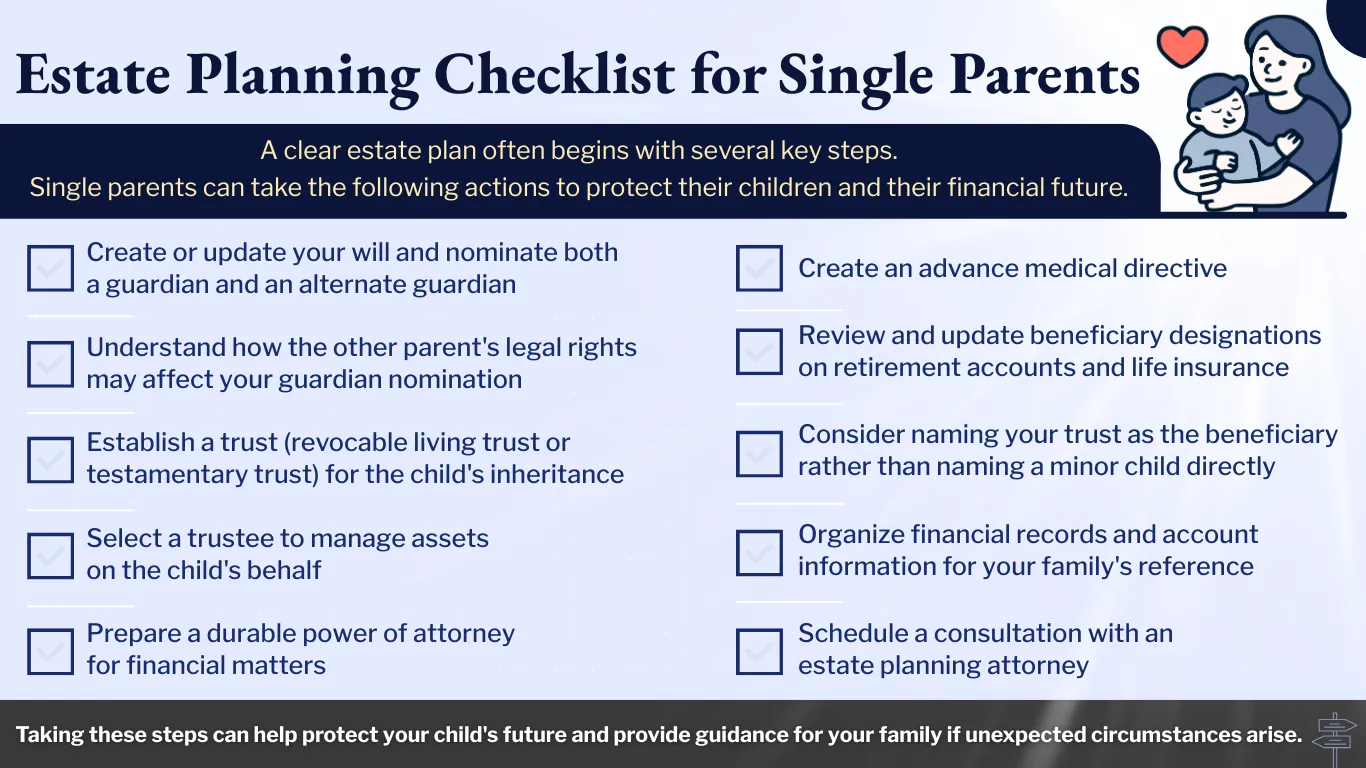
How an Estate Planning Attorney Can Help
 Estate planning decisions can involve complex legal and financial considerations that can be difficult to address without professional guidance. An attorney who focuses on estate planning in Virginia can help you evaluate your specific circumstances and create a plan that protects your child and your assets. An estate planning law firm often assists single parents by:
- Preparing wills and trust documents tailored to your family situation
- Explaining guardianship rules in Virginia and how the other parent's rights may affect your plan
- Helping you determine appropriate asset allocation and trust structure
- Creating strategies for asset protection
- Reviewing and updating beneficiary designations and financial accounts
- Advising on life insurance planning in coordination with trust documents
Because each family situation is unique, estate planning attorneys in Richmond, VA, work closely with clients to create solutions that reflect their personal priorities and legal needs. 
Frequently Asked Questions
Q: Can I prevent the other parent from getting custody of my child if I die? A: In most cases, no. If the other parent is alive, has not had their parental rights terminated, and is legally able to care for your child, Virginia law generally recognizes that parent’s right to assume custody. A guardian nomination in your will does not override those rights. If you have serious concerns about the other parent's fitness, you should discuss your specific circumstances with an estate planning attorney. Documentation of the other parent's situation or a custody arrangement established during your lifetime may be relevant to how the court evaluates things after your death. Q: What happens if my nominated guardian is unable or unwilling to serve? A: This is why naming an alternate guardian is an important part of your estate plan. If your first choice passes away, becomes incapacitated, or cannot take on the responsibility, the court looks to your alternate nomination. Without one, the court will determine who cares for your child without any guidance from you. Review your guardian nominations after major life changes to make sure your plan still reflects your wishes. Q: Do I need a lawyer to create an estate plan in Virginia, or can I do it myself? A: Virginia does not require an attorney, and online tools exist for simple situations. For single parents, however, the stakes are high enough that professional guidance is worth the investment. Virginia has specific execution requirements for wills, and a document that fails to meet them may be invalid when it matters most. An attorney can also help you consider how the other parent's custody rights may affect your plan, structure trust documents correctly, and coordinate beneficiary designations with your overall estate plan. Q: Can I leave money directly to my minor child in my will? You can name a minor child as a beneficiary, but the practical result is often not what parents intend. In Virginia, a minor cannot legally receive or manage an inheritance directly. Under Virginia Code § 64.2-1800, a court may appoint a guardian of the minor’s estate to manage the funds. That role involves court oversight and regular financial reporting under Virginia Code § 64.2-1300. When the child reaches the age of majority under Virginia Code § 1-204, control of the inheritance generally transfers to them outright. A trust allows you to control how and when funds are distributed and can avoid the need for ongoing court-supervised management. Q: Should I name my child or my trust as the beneficiary of my life insurance? A: For most single parents with minor children, naming the trust is the better approach. If you name your minor child directly, the insurance company cannot pay proceeds to the child, and the court will need to appoint a guardian of the estate to manage the funds. That adds delay, expense, and court involvement at an already difficult time. Naming your trust as the beneficiary means proceeds go directly to the trustee, who can use them immediately for your child's housing, education, and healthcare according to your instructions. Coordinate this with your attorney when setting up your trust documents.
Protecting Your Child’s Future Starts With a Thoughtful Estate Plan
Planning for the future as a single parent can bring up difficult questions. You want to know that your child will be cared for, supported, and protected if something unexpected happens to you. Estate planning allows you to make those decisions now so the people and plans you trust are in place when your family needs them most. At PJI Law, PLC, our estate planning attorneys serve clients in Richmond, VA, and throughout Northern Virginia who want to protect their families and organize their legal and financial affairs with care. If you would like to talk through your situation, call (804) 653-3450 to request a consultation. You can also complete our confidential online form if that is more convenient. At PJI Law, you’ll receive white-glove service and personal attention from a team that treats you like family. Copyright © 2026. PJI Law, PLC. All rights reserved.
Copyright © 2026. PJI Law, PLC. All rights reserved.
The information in this blog post (“post”) is provided for general informational purposes only and may not reflect the current law in your jurisdiction. No information in this post should be construed as legal advice from the individual author or the law firm, nor is it intended to be a substitute for legal counsel on any subject matter. No reader of this post should act or refrain from acting based on any information included in or accessible through this post without seeking the appropriate legal or other professional advice on the particular facts and circumstances at issue from a lawyer licensed in the recipient’s state, country, or other appropriate licensing jurisdiction.
3900 Jermantown Road, 2nd Floor
Fairfax, VA 22030
(703) 546-9674
https://www.pjilaw.com
Request A Complimentary Call From Our Team
Provide your details, and we’ll reach out promptly to assist you.