
You may have sat across from your attorney, reviewing the contract you believed would protect your business. When they pointed to a highlighted clause, it became clear: the other party had breached the agreement. Maybe they missed a key deadline. Maybe they failed to deliver what was promised. Either way, the fallout had already begun to affect your operations.
Whether it was unpaid invoices, incomplete services, or repeated delays, the breach disrupted your business and strained relationships with clients, vendors, or partners. In Virginia, legally binding agreements are meant to protect both sides. When one party fails to meet their obligations, the law gives you options.
Before you decide how to move forward, it helps to understand how Virginia law treats breach of contract claims, the consequences of breach of contract, and what steps you can take to protect your business. 
What Makes a Contract Legally Binding in Virginia?
Before you can enforce a contract or recover damages, the court must determine that the agreement was legally valid. In Virginia, not every promise or handshake qualifies as a contract. For an agreement to be enforceable, it must meet certain basic requirements.
Key Elements of a Legally Binding Agreement
A valid contract generally includes the following:
- Offer and Acceptance: One party makes an offer, and the other party accepts it
- Mutual Intent to be Bound: Both parties understand and agree that the contract is legally enforceable
- Consideration: Each party provides something of value, such as payment, goods, services, or a promise
- Clear Terms: The agreement sets out key details, including obligations, payment schedule, timelines, and other material provisions
- Capacity and Legality: The parties must be legally allowed to enter into a contract, and the subject of the agreement must be lawful
While informal or verbal agreements can be legally binding in Virginia, written contracts are easier to prove in court, especially if the other party denies what was agreed.
What Is Considered a Breach of Contract in Virginia?
A breach of contract happens when one party fails to do what they promised under a legally binding agreement. That could mean missing a payment deadline, failing to deliver goods or services, or refusing to honor important contract terms without a valid reason.
In Virginia, contract law is based on common law, meaning it’s shaped by past court decisions, not just statutes. Unless a specific law applies (like the Statute of Frauds or the Uniform Commercial Code), most contract disputes are resolved using long-standing legal principles.
To bring a breach of contract claim, you usually need to show that:
- A valid contract existed
- You met your obligations (or were legally excused from doing so)
- The other party failed to uphold their end
- You suffered financial loss because of it
This standard comes from Virginia case law, including Ulloa v. QSP, Inc., 271 Va. 72 (2006), where the court explained the basic requirements for a breach of contract claim. 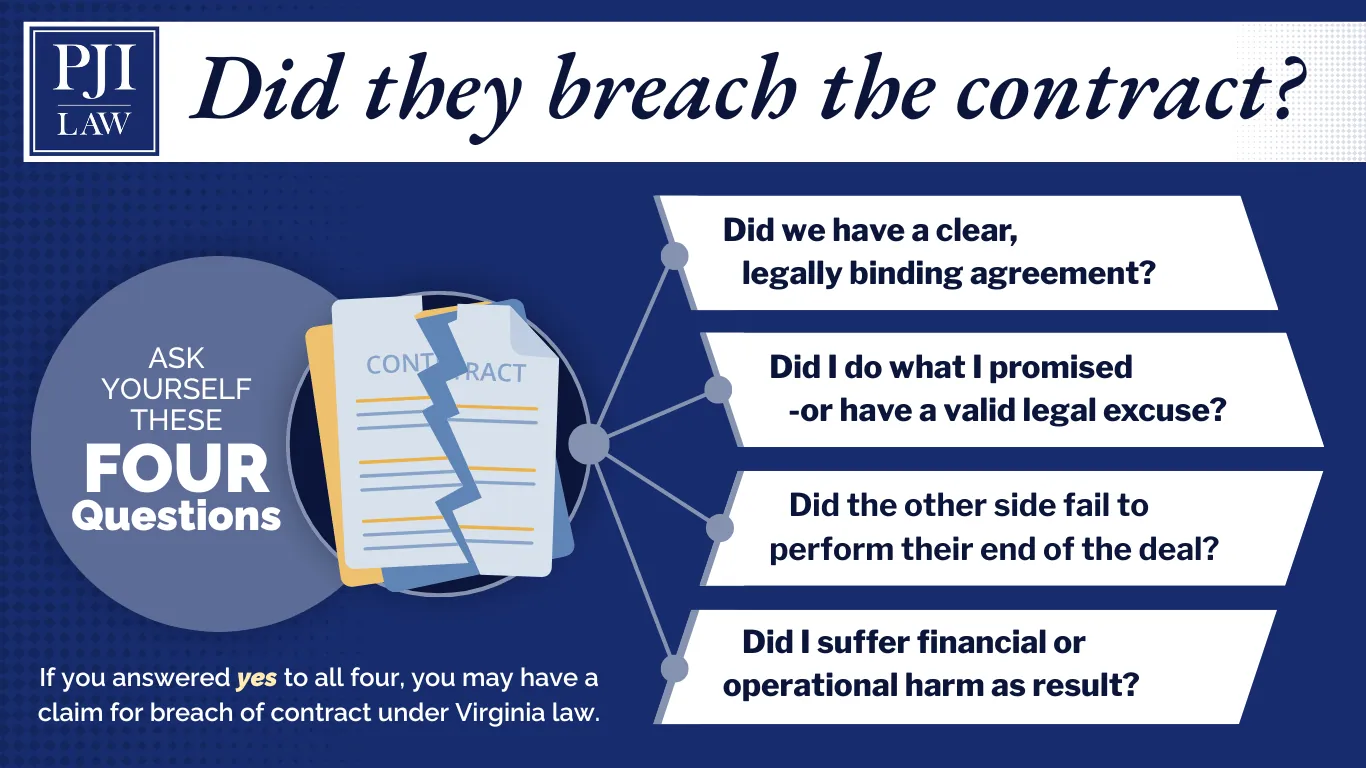
Different Types of Breaches and Why They Matter
Not every breach carries the same weight. In Virginia, some contract violations are more serious than others, and your case’s outcome often depends on whether the court sees the breach as material or minor. Courts treat a breach as material when it substantially defeats the purpose of the agreement or deprives you of what you were promised.
Material Breach
A material breach happens when one party fails to perform a key part of the contract. This usually excuses you from continuing to perform and may give you the right to end the contract or seek damages. Courts look at how much the breach undermines the agreement’s main purpose.
Examples include:
- A vendor fails to deliver goods essential to your operations
- A contractor performs work so poorly that it substantially fails to meet agreed standards
- One party discloses information protected by a non-disclosure agreement
If the breach causes business delays, lost income, or missed opportunities, the breaching party may be held responsible for those losses. Courts may award compensatory damages or allow you to cancel the contract, depending on how serious the breach was and whether you can prove the harm.
Minor (or Partial) Breach
A minor breach, sometimes called a partial breach, happens when one party fails a small part of the agreement but still delivers the overall benefit. In this case, you may still need to fulfill your side of the contract, though you can often recover damages for the shortfall.
Examples include:
- A supplier delivers most of your order on time but falls short by a few units
- A subcontractor uses slightly lower-quality materials, but the result still functions as agreed
If the breach results in financial loss or extra costs, you’ll need evidence, such as invoices or communications, to support your claim. Keep in mind that a minor breach doesn’t usually justify terminating the contract.
Anticipatory Breach
Sometimes, it’s clear the other party has no intention of following through before their performance is even due. This is called anticipatory breach, and Virginia law allows you to take legal action as soon as that refusal becomes clear.
For example, if a supplier emails you saying they’re not going to deliver your order, you don’t have to wait for the delivery deadline. You can seek damages or cancel the agreement right away.
Breaches can happen in different ways, and the law doesn’t always label them the same way you would in everyday life. Here are some of the more common breach scenarios Virginia courts deal with:
Common Examples of Contract Breaches in Virginia
While Virginia law classifies breaches as material, minor, or anticipatory, many business owners think about breaches in terms of what actually went wrong. Here are some of the most common issues:
- Failure to Perform: One party doesn’t follow through, whether that means delivering products, completing services, or meeting deadlines.
- Delayed Performance: Work or payment happens too late to meet the agreement’s terms. If timing was essential to the contract, the breach may be treated more seriously.
- Non-Payment: One side receives goods or services but doesn’t pay what was owed. This can lead to claims for damages, interest, or legal fees.
- Impossibility: Sometimes, an unforeseen event like a supply chain collapse or a change in the law makes performance impossible. In rare cases, this may excuse a breach, but only if the event was truly unexpected, beyond the party’s control, and not caused by their own actions.
Legal Consequences of Breach of Contract in Virginia
When someone breaches a contract, Virginia law gives you options to recover what you’ve lost and protect your interests. The specific remedy depends on the terms of the agreement, the type of breach, and how the breach affected your business or finances. In most cases, the court’s goal is to put you in the position you would have been in if the agreement had been fulfilled as promised. 
Compensatory Damages
This is the most common remedy. If the other party caused financial harm by failing to perform, you may be able to recover damages based on your actual losses. These damages might include:
- Lost income or profits
- Costs for substitute goods or services
- Additional expenses caused by the breach
- Lost benefits you reasonably expected from the agreement
To recover compensation, you'll need to show that the losses were directly caused by the breach, not by unrelated events. Documentation like signed agreements, emails, and payment records can strengthen your claim.
Virginia law also allows buyers of goods to recover damages when a seller fails to deliver. In those cases, you may be able to recoup the cost of replacing the goods elsewhere (Va. Code § 8.2-712).
Specific Performance
In certain cases, a court may order the breaching party to fulfill their original obligations instead of awarding money damages. This remedy is called specific performance and typically applies when:
- The subject of the contract is unique (such as real estate or a rare item)
- Monetary damages wouldn’t fully compensate you for the loss (Va. Code § 8.2-716)
For example, if you had a signed agreement to buy a specific piece of land and the seller backs out, a court might require them to follow through on the deal.
Courts are generally reluctant to apply specific performance to service contracts, especially when the work requires close supervision or ongoing performance.
Rescission and Restitution
In some cases, the court may cancel the contract entirely and attempt to return both parties to the positions they were in before the agreement. This is called rescission, and it’s often paired with restitution, which involves returning any money, goods, or property exchanged under the contract.
Rescission may be appropriate when:
- The breach is so serious that it defeats the purpose of the contract
- The agreement was based on fraud, misrepresentation, or mistake
- Continued performance would be unfair or impractical
For example, if a contractor was paid upfront but never performed any work, and their failure undermines the entire deal, you may be able to ask the court to rescind the contract and recover the amount you paid.
Rescission is an equitable remedy, which means it’s not automatic. A judge will weigh the facts and decide whether unwinding the contract is fair and appropriate under the circumstances.
Liquidated Damages
Some contracts include a clause that sets a fixed dollar amount to be paid if a breach occurs. This is known as a liquidated damages provision. Virginia courts will enforce these clauses if:
- The amount reasonably reflects the expected harm
- The harm was difficult to estimate at the time of the agreement
- The amount isn’t excessive or meant to punish the breaching party (Va. Code § 8.2-718)
For example, if your agreement includes a $500 per-day fee for late delivery and that amount fairly reflects the expected financial loss, a court is likely to enforce it.
Negotiated Settlement
Not every contract dispute ends up in court. In many cases, both parties are willing to talk through the problem and reach a resolution that avoids the stress, cost, and uncertainty of litigation. With a knowledgeable contract lawyer guiding the conversation, it’s often possible to resolve the matter through direct negotiation, mediation, or another form of alternative dispute resolution. Whether you're trying to recover payment, fix a performance issue, or exit an agreement, this approach may lead to a fair outcome and help preserve important business relationships in the process.
How Courts Review Contracts During Disputes
However, if a breach occurs and you file a lawsuit, the court will review the agreement carefully. Judges typically ask:
- Was there a valid contract between the parties involved?
- Did one party fail to perform their obligations without a valid excuse?
- Did the other side rely on the contract in good faith?
- What was the expected benefit under the contract?
- Can damages be reasonably calculated?
The court may also consider whether any ambiguity exists in the language of the agreement and how both sides acted during the course of the contract. If one party breached and the other continued to perform without objection, that could affect the outcome.
Why Contract Reviews Matter Before and After a Dispute
Many contract disputes in Virginia could be avoided with a careful review before the agreement is signed. Others are easier to resolve when both parties understand their rights and obligations from the start. Whether you’re working with an existing client, hiring an independent contractor, or entering a new business relationship, reviewing the contract at the right time can save you from bigger problems later.
Before Signing a New Contract
Legal contract lawyers can assist with:
- Spotting vague, overly broad, or one-sided provisions
- Confirming the contract complies with Virginia law
- Drafting clear language for payment terms, performance timelines, confidentiality clauses, and termination provisions
- Reducing the risk of future disputes by addressing common failure points up front
Even straightforward agreements, such as non-disclosure clauses or basic payment terms, can trigger disputes if they’re poorly written or improperly executed.
After a Breach Occurs
If one party hasn’t followed through, or if you’ve been accused of breaching a contract, it’s important to seek legal advice before responding. A breach of contract attorney can:
- Review the contract and related communications
- Assess whether a material breach has occurred
- Evaluate the potential for liability and damages
- Represent your position in negotiations, dispute resolution, or litigation
Some conflicts can be resolved through direct discussion. Others may involve mediation, arbitration, or court action. How you respond early can affect the outcome if the matter escalates.
How Long Do You Have to File a Breach of Contract Lawsuit in Virginia?
If the other party fails to meet their obligations, you only have a limited time to take legal action. In Virginia, the deadline to file a breach of contract lawsuit depends on whether the agreement was written or oral.
Virginia’s General Time Limits
Under Virginia Code § 8.01-246:
- Written contracts: You typically have five years from the date the breach occurs
- Oral contracts: You generally have three years from the date of the breach
These deadlines apply to most business agreements, including contracts for services, payment schedules, and NDAs.
It’s not enough to know a breach happened. You must file your claim before the deadline passes. If you wait too long, you may lose your right to recover damages, even if the other party clearly violated the contract.
What Can Pause the Clock?
In limited situations, the statute of limitations may be paused or extended. This is known as “tolling.” It may apply if:
- The other party intentionally concealed the breach
- Both parties agreed in writing to pause the time period
These exceptions are fact-specific and not automatic. If you believe you’re running out of time or aren’t sure when the clock started, talk to a lawyer as soon as possible. Early legal review gives you more control over your options and lowers the risk of losing your claim. 
When Legal Action Makes Sense
If a contract dispute is already affecting your business, or if you’re unsure whether the other party’s actions qualify as a breach, it may be time to involve a contract lawyer. The sooner you understand your rights and options, the more control you’ll have over how the dispute plays out.
Dealing with a Contract Dispute in Virginia?
Whether you're reviewing a new agreement, responding to a breach, or preparing to take legal action, having the right legal support can make all the difference. At PJI Law, we represent business owners, service providers, and professionals across Virginia in contract disputes involving clients, vendors, contractors, and other parties.
We draft and review legally binding agreements, negotiate on your behalf, and represent your interests in and out of court. Our goal is to protect your business from uncertainty, limit future risk, and resolve disputes in a way that supports your long-term goals. Your online search for a “contract lawyer near me” or “breach of contract attorney” brought you here. We invite you to take the next step and call us at (703) 865-6100. If more convenient, you can fill out our confidential online form to schedule your consultation today.
From the first conversation, our legal team takes the time to understand what’s at stake and work toward a resolution that supports your business. At PJI Law, you’ll receive white glove service and personalized attention!
Copyright © 2025. PJI Law, PLC. All rights reserved.
Copyright © 2026. PJI Law, PLC. All rights reserved.
The information in this blog post (“post”) is provided for general informational purposes only and may not reflect the current law in your jurisdiction. No information in this post should be construed as legal advice from the individual author or the law firm, nor is it intended to be a substitute for legal counsel on any subject matter. No reader of this post should act or refrain from acting based on any information included in or accessible through this post without seeking the appropriate legal or other professional advice on the particular facts and circumstances at issue from a lawyer licensed in the recipient’s state, country, or other appropriate licensing jurisdiction.
3900 Jermantown Road, 2nd Floor
Fairfax, VA 22030
(703) 546-9674
https://www.pjilaw.com
Request A Complimentary Call From Our Team
Provide your details, and we’ll reach out promptly to assist you.