Caroline, a lifelong Richmond resident, recently faced a difficult and unexpected situation. When her beloved uncle, David, passed away suddenly, he left no will. As the family's go-to person for handling such matters, Caroline found herself overwhelmed with questions about what would happen to David's estate. With no written directive from her uncle, she had no idea about his preferences for administering his estate or even where to start.
Through this experience, Caroline discovered the complexities of intestate succession in Virginia. The legal process of determining the distribution of property and assets when someone dies without a valid will, intestate succession determines the distribution of a decedent's assets and property among surviving relatives.
This blog, from a knowledgeable and experienced Richmond estate planning attorney, delves into the specifics of intestate succession. Whether dealing with an estate for which a decedent did not establish a valid will or planning to protect your own assets, understanding these laws is crucial. Continue reading to learn more about how intestate succession works, who stands to inherit, and the steps you need to take.
For personalized service and attention, contact PJI Law at (804) 653-3450. Discover how establishing a will as part of a comprehensive estate plan can help you avoid complex situations and ease your family's burdens after you pass away.
Who are the Heirs at Law in Virginia?
As Virginia probate attorneys know, when a person dies without a will, laws of intestate succession determine who stands to inherit from an estate and in what order. These individuals are the heirs at law. !
In general, Virginia intestate succession abides by the following:
- If the decedent had a surviving spouse but no children, the spouse receives all assets.
- If the decedent had a surviving spouse and all children are shared with that spouse, the spouse receives all assets.
- If the decedent had a surviving spouse and any child(ren) from a previous relationship, the spouse receives one-third of the estate, and the remaining two-thirds is divided equally among all surviving children or their descendants.
- If the decedent had no surviving spouse but has children, the assets are divided equally among all surviving children or their descendants.
- If there is no surviving spouse or children, the decedent’s parents inherit everything.
- If there is no surviving spouse, children, or parents, the decedent’s surviving siblings and their descendants inherit everything.
- If there is no immediate family (spouse, children, grandchildren, parents, or siblings), more distant relatives may be entitled to inherit according to Virginia's intestate succession laws.
Complications arise in cases of blended families, adopted children, or situations where a child has died before the decedent. Consulting trust and estate counsel can help you clarify these circumstances and reach an amicable resolution. 
Terms to Know Concerning Virginia Wills and Intestate Succession
Term
Definition
Wills
Legal documents that outline how a person's assets and affairs should be handled after their death.
Administrator
A person appointed by the court to manage and distribute the estate of a deceased person who died without a will.
Beneficiaries
Individuals or entities designated to receive assets or benefits from a will or estate.
Decedents
Persons who have died, particularly in relation to their estate.
Escheat
The process by which unclaimed or abandoned property reverts to the state.
Executor
An individual appointed in a will to administer the estate and carry out the wishes of the deceased.
Heir
A person who is legally entitled to inherit some or all of the estate of another person who has died intestate.
Intestate
The condition of having died without a valid will in place.
Intestate Succession
The legal process for distributing the assets of a deceased person who did not leave a valid will.
Per Stirpes
A method of distribution where descendants inherit a deceased person's estate by branch, ensuring each branch receives an equal share.
Probate
The legal process of verifying a will's validity and administering the deceased's estate.
Probate Tax
Taxes imposed on the estate of a deceased person during the probate process.
Testate
The condition of having died with a valid will in place.
Testator
An individual who has made a will or given a testament.
Virginia Probate Attorneys Explain the Process
Navigating probate in Virginia can be straightforward for those with a will, known as testate estates. A valid will guides the court in distributing the estate according to the deceased's wishes. However, not all testate estates are handled the same way since the nature of the estate determines the probate court's approach.
Estates excluding real estate and consisting of personal property valued at $50,000 or less are classified as "small estates" under Virginia's inheritance laws. Such estates can skip probate if 60 days have passed since the individual's death. On the other hand, larger estates must undergo formal probate administration.
Understanding the distinction between real and personal property is essential. Real property includes land and attached structures like houses, while personal property encompasses items such as cars, furniture, jewelry, and financial investments. Assets like insurance policies and IRAs are typically not subject to probate and can be handled separately if properly designated.
In situations where there is no will, the court appoints an administrator to oversee the estate, prioritizing relatives of the deceased based on a specific order. The administrator manages debts and distributes assets according to intestacy laws.
Whether a valid will exists or not, an estate must settle debts such as taxes, expenses, and liabilities before distributing assets to heirs. This duty falls on either the executor named in the will or the administrator appointed by the court.
In Virginia, circuit courts handle probate cases in the county where the deceased lived for proper legal oversight and administration of estates. 
Summary of Virginia Intestate Succession
Inheritance Rights of Surviving Spouses
In Virginia, if a decedent dies without a will, their spouse is entitled to a significant portion of the estate. The specific inheritance rights depend on whether the decedent had children and whether those children are shared with the spouse. If there are no children or other descendants, the spouse typically inherits the entire estate. If the marriage resulted in children with the decedent, the surviving spouse receives the entire estate. If there are any children/descendants from a separate relationship, the spouse receives one-third of the estate and the remaining two-thirds are divided between all children.
Inheritance Rights of Children
According to VA Code 64.2-200, if the deceased has a surviving spouse and children (or their descendants) who are not also the children of the surviving spouse, the children receive two-thirds of the estate and the surviving spouse receives one-third.
If all children are also the children of the surviving spouse, the entire estate goes to the surviving spouse. If there is no surviving spouse, the deceased’s children and their descendants receive the entire estate. Virginia law treats adopted children the same as biological children.
Unmarried Individuals Without Children
For unmarried individuals without children, the estate is distributed to other family members according to a specific hierarchy. If the deceased did not leave behind a spouse or children, the decedent's parents inherit everything. If the parents have also passed, the estate transfers to the decedent's siblings. In the absence of immediate family such as parents or siblings, more distant relatives like aunt, uncles, nieces, nephews, or cousins may inherit. If no relatives can be found, the estate may eventually escheat to the state of Virginia. This hierarchy ensures the distribution of the decedent's assets to their family members in a manner reflecting their closest biological or legal relationships.
Unclaimed Estate / No Surviving Heirs
When no heirs are found, the estate is transferred to Virginia. Creditors can also step in to manage the estate if there are outstanding debts.
What are Non-Probate Assets?
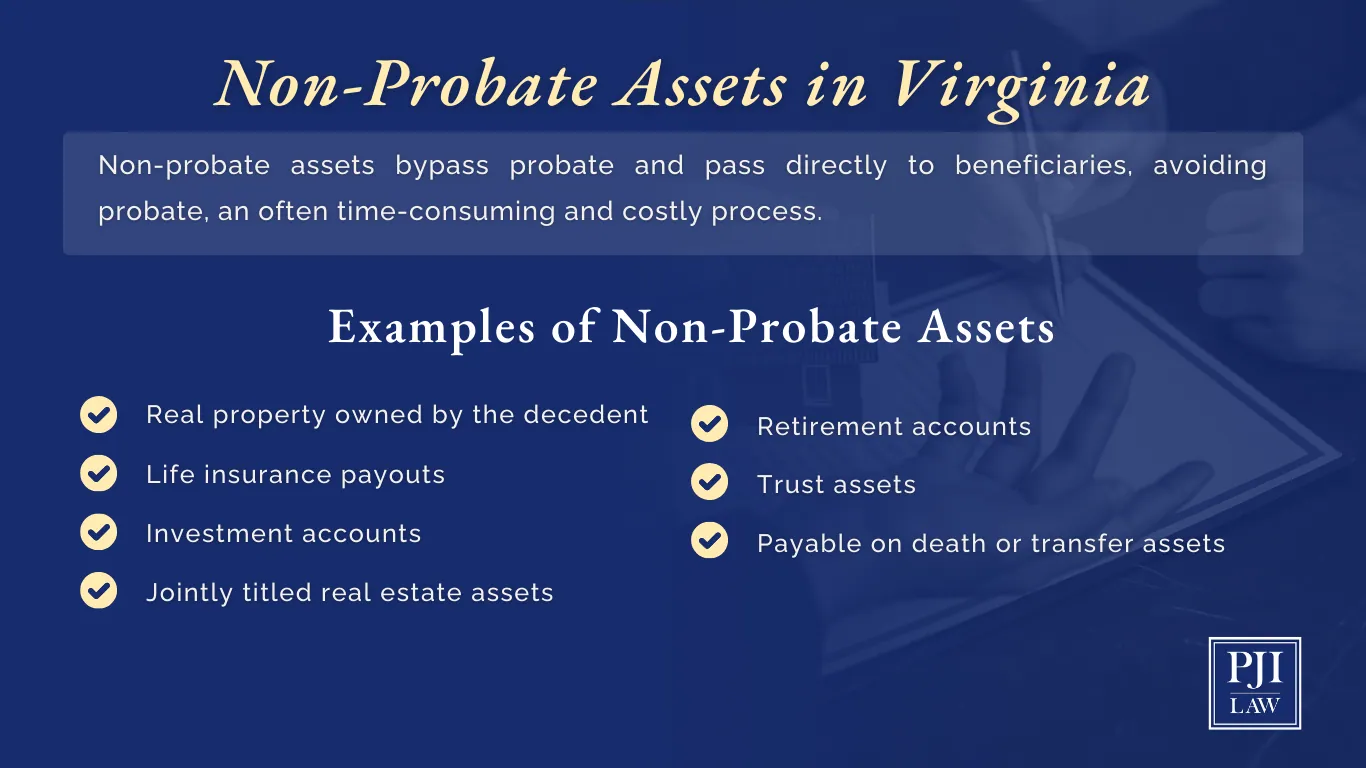
As an estate attorney knows, non-probate assets bypass probate and pass directly to beneficiaries, avoiding an often time-consuming and costly process.
Examples of Non-Probate Assets
Non-probate assets can include:
- Real property owned by the decedent if there’s a transfer-on-death (TOD) deed
- Life insurance payouts
- Investment accounts
- Jointly titled real estate assets
- Retirement accounts
- Trust assets
- Payable on death or transfer on death assets
If an asset is owned with right of survivorship or has been proper beneficiary designated, these assets can be distributed directly to a beneficiary or beneficiaries without the requirement of probate, offering a more efficient vehicle for transferring assets and reducing the hardships on loved ones during a time of grief. Consulting a knowledgeable estate attorney can help you manage your non-probate assets and distribute them in alignment with your desires.
Naming Beneficiaries
Naming a beneficiary or beneficiaries for non-probate assets facilitates a smooth transfer of assets and prevents potential disputes among heirs. Non-probate assets, such as life insurance policies, retirement accounts, and bank accounts, generally require the completion and submission of a designated beneficiary form to the relevant financial institution.
Keeping these forms current is critical for transferring the assets to the designated beneficiary. A seasoned estate planning lawyer knows that taking the time to designate beneficiaries for your non-probate assets enables you to design a comprehensive estate plan that maximizes the value of your assets and offers your loved ones financial security.
Protecting Your Assets: The Importance of Wills & Comprehensive Estate Planning
While intestate succession laws provide for the distribution of assets in the absence of a will, they may not align with your personal wishes or values. Furthermore, without a will, you have no control over who will manage your estate and cannot ensure the proper care of your loved ones after you pass away.
Creating a will allows you to make clear and specific directives about how your assets should be distributed and who should oversee this process. You can also include provisions for minor children or dependents and designate guardianship. By outlining your wishes in a will, you can potentially avoid conflicts and disputes among family members after your passing.
However, comprehensive estate planning goes beyond just creating a will. Other critical documents such as powers of attorney and advance medical directives can secure the management of your affairs if you become incapacitated or unable to make decisions for yourself. These documents also alleviate the burden on loved ones who would have to make difficult decisions without your guidance. 
How Can Virginia Estate Planning Lawyers Help?
Estate administration — the maintenance and distribution of your assets after death, which includes probate — involves settling estate taxes and debts and carrying out your wishes. Due to the complexities of the laws surrounding these matters, consulting knowledgeable and experienced Richmond estate planning attorneys can protect your assets and distribute them according to your wishes.
A lawyer well-versed in estate planning will work closely with you to understand your goals and develop a personalized plan that meets your specific needs, assist with the preparation of legal documents, provide guidance on asset protection strategies, and offer insights into how to minimize potential estate taxes or other financial obligations upon your passing.
A will forms the foundation of a well-devised estate plan, but estate planning does not end there. Depending on your unique circumstances and goals, your attorney may recommend trusts, powers of attorney, and other legal instruments. More complex situations may require business succession planning if you're a business owner or a transfer-on-death deed if you're concerned about what will happen to your home after you pass away.
PJI Law: Experienced Probate Attorneys & Estate Planning Attorneys in Richmond, Virginia
For grieving family members, undergoing intestate succession can be overwhelming and time-consuming. Don't leave your estate administration to chance by failing to establish a will as the foundation of a well-designed estate plan. Take control of your legacy and care for your loved ones after your passing by consulting an experienced estate planning attorney. Have you been typing "probate attorneys near me" or "estate law firms near me" into your search bar?
Whether you have recently lost a loved one and need assistance navigating intestate succession, or want to create an estate plan for yourself, contact PJI Law at (804) 653-3450 to schedule a consultation.
When you hire a knowledgeable and experienced lawyer from PJI Law, you can expect personalized service and attention from our entire team and peace of mind knowing you have prepared well for the future. Let PJI Law be your guide and advocate.
Copyright © 2024. PJI Law, PLC. All rights reserved.
Copyright © 2026. PJI Law, PLC. All rights reserved.
The information in this blog post (“post”) is provided for general informational purposes only and may not reflect the current law in your jurisdiction. No information in this post should be construed as legal advice from the individual author or the law firm, nor is it intended to be a substitute for legal counsel on any subject matter. No reader of this post should act or refrain from acting based on any information included in or accessible through this post without seeking the appropriate legal or other professional advice on the particular facts and circumstances at issue from a lawyer licensed in the recipient’s state, country, or other appropriate licensing jurisdiction.
3900 Jermantown Road, 2nd Floor
Fairfax, VA 22030
(703) 546-9674
https://www.pjilaw.com
Request A Complimentary Call From Our Team
Provide your details, and we’ll reach out promptly to assist you.