
PJI Law's College-Bound Legal Protection Package
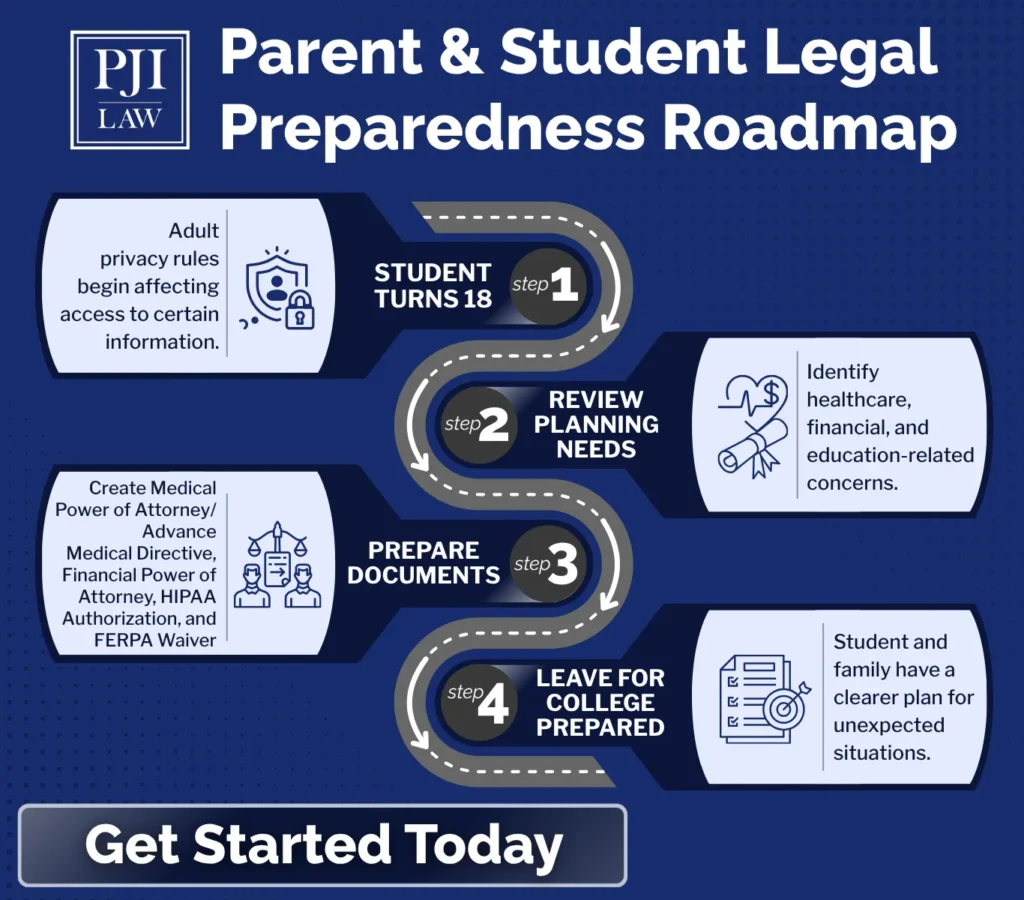
Preparing for college involves more than selecting classes, arranging housing, and purchasing supplies. Once your child turns 18, they become a legal adult under Virginia law. Although many parents continue providing financial and personal support, they may no longer have automatic authority to access certain medical information, communicate with a college, or assist with some financial matters without the student's written authorization.
PJI Law helps families throughout Virginia prepare a power of attorney for college students as part of a comprehensive college student planning package. The package brings together several essential legal documents for young adults, allowing families to address healthcare, financial, and educational planning before move-in day through one coordinated process tailored to the student's needs and wishes.
Our College-Bound Legal Protection Package includes:
- Financial Power of Attorney
- Medical Power of Attorney / Advance Medical Directive
- HIPAA Authorization
- FERPA Waiver
Whether your child plans to attend a Virginia college, enroll in an out-of-state university, or participate in a study abroad program, preparing these documents before leaving home may help your family respond more confidently if unexpected circumstances arise.
Key Takeaways
Before discussing each document in greater detail, it helps to understand a few important points:
- A child generally becomes a legal adult at age 18, even if they are still financially dependent on their parents.
- Privacy laws may limit a parent's ability to access medical information or educational records without written authorization.
- A complete college-bound legal planning package typically includes more than a single power of attorney.
- Preparing these documents before move-in day is often simpler than trying to address them during an emergency.
- Students remain in control of these documents and decide who may act on their behalf.
- PJI Law prepares personalized college-bound legal planning documents for families throughout Virginia.
Why Parents Often Lose Certain Legal Rights When Their Child Turns 18
One of the biggest surprises for many families occurs on a student's eighteenth birthday.
Although parents may still help pay tuition, maintain health insurance coverage, or provide financial support, the law generally recognizes the student as an adult. That legal change affects how hospitals, physicians, colleges, universities, banks, and other organizations communicate with family members.
Without appropriate legal documentation, organizations may be unable to discuss certain matters with parents, even during stressful situations.
For example, parents may encounter questions such as:
- Can a physician discuss treatment after an accident?
- Can a hospital provide updates during an emergency?
- Can a university discuss certain educational records?
- Can someone help manage financial matters if the student is temporarily unable to do so?
These situations often arise unexpectedly. Preparing appropriate legal documents in advance may help families avoid unnecessary delays while respecting the student's legal rights and privacy.
Privacy Laws Affect Healthcare and Education
Two federal laws commonly affect college-bound families.
The Health Insurance Portability and Accountability Act (HIPAA) protects private medical information. After a child becomes an adult, healthcare providers generally need appropriate authorization before discussing protected medical information with parents or another trusted individual.
Similarly, the Family Educational Rights and Privacy Act (FERPA) protects educational records. Colleges and universities generally look to the student, not the parent, for permission to disclose information covered by FERPA.
These laws exist to protect the student's privacy. They also explain why preparing documents before college begins has become an important part of young adult legal planning.
College-Bound Legal Planning Involves More Than One Document
Many people believe that preparing a power of attorney alone addresses these concerns. Different situations call for different legal documents, and each serves a distinct purpose. Together, these documents create a coordinated legal planning package that reflects the student's decisions while helping families prepare for situations that may arise during the college years.
PJI Law's College-Bound Legal Protection Package
A well-prepared college legal planning package involves more than completing a single form:
- A Financial Power of Attorney addresses designated financial matters.
- A Medical Power of Attorney / Advance Medical Directive allows a student to document healthcare preferences while identifying an individual who may assist if the student cannot communicate those wishes.
- A HIPAA Authorization addresses access to protected medical information.
- A FERPA Waiver addresses certain educational records.
When combined, these documents can help a student identify who they trust to assist with healthcare, financial, and educational matters while preserving the student's independence and decision-making authority.
Rather than preparing documents separately over time, many Virginia families choose to complete them together before college begins. This coordinated approach helps create a clearer plan before move-in day and reduces the likelihood of searching for documents during a stressful situation.
PJI Law's College-Bound Legal Protection Package includes these five core documents that work together to support college-bound students and their families.
At-a-Glance Comparison of the Documents
| Document | Primary Purpose | When It May Help |
|---|---|---|
| Financial Power of Attorney | Authorizes a trusted person to assist with certain financial matters identified by the student. | Banking questions, insurance matters, document signing, or other authorized financial responsibilities. |
| Medical Power of Attorney (Advance Medical Directive) | Documents healthcare wishes and identifies an individual to assist if the student cannot express those wishes. | Medical emergencies involving temporary or long-term incapacity. |
| HIPAA Authorization | Allows designated individuals to access approved protected medical information. | Communication with physicians, hospitals, specialists, or a college health clinic. |
| FERPA Waiver | Allows a school to disclose approved educational records to designated individuals. | Academic, enrollment, or administrative matters identified by the student. |
Financial Power of Attorney
A Financial Power of Attorney allows a student to appoint a trusted person to assist with certain financial matters identified within the document. Although many students manage these responsibilities independently, situations sometimes arise where temporary assistance becomes helpful.
Examples include:
- Communicating with financial institutions
- Handling certain insurance-related matters
- Completing authorized paperwork
- Managing limited financial responsibilities while the student is unavailable
- Assisting during a study abroad program or temporary medical situation
A properly prepared Financial Power of Attorney does not transfer ownership of the student's finances. Instead, it authorizes another person to act only within the authority granted by the document and in accordance with applicable Virginia law.
Medical Power of Attorney / Advance Medical Directive
A Medical Power of Attorney (Advance Medical Directive) focuses on healthcare decisions rather than financial matters.
If a student cannot communicate their wishes because of an accident or illness, this document identifies the person who may speak with healthcare providers and participate in healthcare decision-making as authorized by the document and Virginia law.
Depending on the circumstances, a Medical Power of Attorney / Advance Medical Directive may become relevant during:
- Emergency hospitalization
- Surgery
- Serious illness
- Temporary incapacity
- Other healthcare situations covered by the document
For parents, this document often provides reassurance that the student has thoughtfully selected the individual they want involved in important healthcare discussions should those discussions become necessary.
Unlike a HIPAA Authorization, which addresses access to information, a Medical Power of Attorney / Advance Medical Directive focuses on healthcare decision-making when the circumstances described in the document exist.
Advance Medical Directive
An Advance Medical Directive, sometimes referred to as a living will, allows a student to document personal healthcare wishes while also identifying the individual they would like to be involved if they cannot communicate those wishes themselves.
Although many parents associate advance directives with older adults, they can also play an important role for college students. A serious accident or unexpected illness could temporarily prevent a young adult from making or communicating healthcare decisions.
An Advance Medical Directive allows the student to express personal preferences regarding future medical care while helping reduce uncertainty for family members during a difficult time.
This document complements, rather than replaces, a Medical Power of Attorney. Together, they help create a more complete healthcare planning strategy.
HIPAA Authorization
A HIPAA Authorization addresses a different issue than a Medical Power of Attorney.
The Health Insurance Portability and Accountability Act (HIPAA) protects private medical information. Once a child becomes an adult, physicians, hospitals, specialists, and other healthcare providers generally need the student's written authorization before discussing protected medical information with parents or another trusted individual.
A HIPAA Authorization may allow designated individuals to communicate with:
- Physicians and specialists
- Emergency departments
- Hospitals
- A college health clinic
- Laboratories
- Pharmacies
- Other authorized medical providers
Without this authorization, parents may have difficulty obtaining updates about their child's condition, even when they are paying for health insurance or traveling to be with their child during an emergency.
It is important to recognize that a HIPAA Authorization primarily concerns access to medical information. It does not automatically grant authority to make healthcare decisions. That role is addressed separately through a Medical Power of Attorney.
FERPA Waiver
Many parents are surprised to learn that healthcare privacy is only part of the picture.
The Family Educational Rights and Privacy Act (FERPA) generally gives college students control over their educational records once they become eligible under federal law. Even when parents pay tuition or remain closely involved in their child's education, colleges and universities may limit what information they can disclose without the student's written consent.
A FERPA Waiver allows a student to authorize the release of approved educational records to designated individuals.
Depending on the student's instructions, the authorization may include information related to:
- Enrollment status
- Academic records
- Financial aid communications
- Student account matters
- Disciplinary information when authorized
- Other educational records identified by the student
Without a FERPA Waiver, parents may encounter unnecessary delays when attempting to discuss administrative issues with a college or university.
Including a FERPA Waiver alongside the other documents in the College-Bound Legal Protection Package creates a more comprehensive legal planning approach for students beginning this next chapter of life.
Why Completing the Entire Package Makes Sense
Each document serves a different purpose. Preparing only one document may leave important gaps that become apparent only after an unexpected situation arises.
Rather than asking whether a student needs a Financial Power of Attorney, a Medical Power of Attorney, or a FERPA Waiver, many families find it more helpful to ask a broader question:
"If something unexpected happens after our child leaves for college, have we prepared the documents that address healthcare, financial, and educational matters?"
That question reflects the purpose of PJI Law's College-Bound Legal Protection Package.
By preparing these documents together, families can:
- Reduce uncertainty before college begins
- Discuss important decisions while everyone is together
- Document the student's wishes in advance
- Prepare for healthcare, financial, and educational situations that may arise
- Move into the college years with a clearer legal planning strategy
PJI Law works with families throughout Virginia to prepare these documents in one coordinated planning process. Each package is tailored to the student's circumstances and preferences rather than relying on generic online forms.
When College-Bound Legal Documents May Matter Most
Parents rarely prepare these documents because they expect something to go wrong. Instead, many families choose to plan ahead because they recognize that college introduces new responsibilities, greater independence, and situations where timely communication can become important.
Whether your child attends a university in Virginia, studies in another state, or participates in a study abroad program, preparing legal documents before move-in day may help avoid unnecessary delays if unexpected circumstances arise.
Medical Emergencies Away From Home
One phone call can change an ordinary day.
If a student is involved in an accident, experiences a serious illness, or requires emergency treatment, parents naturally want information and want to be available to help. Depending on the circumstances, healthcare providers may be limited in what they can discuss without appropriate authorization.
A coordinated legal planning package may help address situations involving:
- Communication with physicians and hospital staff
- Access to authorized medical information
- Healthcare decision-making when permitted under applicable documents
- Coordination of care with family members
- Questions involving insurance or follow-up treatment
Preparing these documents in advance allows the student, rather than an emergency, to determine who should be involved.
Financial Matters While a Student Is Away
College often brings new financial responsibilities. Students may open new bank accounts, sign apartment leases, purchase vehicles, travel internationally, or manage insurance and tuition-related expenses.
If the student becomes temporarily unavailable because of illness, travel delays, or another circumstance, a Financial Power of Attorney may allow a trusted individual to assist with authorized financial matters.
- Communicating with financial institutions
- Handling authorized banking issues
- Managing certain insurance matters
- Completing approved paperwork
- Addressing time-sensitive financial responsibilities while the student is unavailable
Study Abroad and Extended Travel
Students participating in study abroad programs often encounter additional planning considerations.
Different time zones, international travel, language barriers, and distance from family can make unexpected situations more complicated.
Before departure, families may wish to review:
- Healthcare planning documents
- Emergency contact information
- Financial planning documents
- Insurance coverage
- Passport and travel information
- Updated legal documents that reflect the student's current wishes
Completing these steps before international travel often provides greater peace of mind for both students and parents.
Educational Records and Administrative Questions
Parents frequently remain involved in college planning long after move-in day. They may help with tuition payments, financial aid paperwork, housing questions, or academic planning.
A FERPA Waiver may allow the student to authorize the release of certain educational records so designated individuals can participate in approved communications with the institution.
Rather than attempting to complete paperwork during a stressful situation, preparing the authorization beforehand allows the student to make those decisions on their own timetable.
What Happens Without These Documents?
Many families do not realize these issues exist until they experience them firsthand.
Without appropriate legal planning, situations may arise where parents encounter delays involving:
- Access to certain medical information
- Communication with healthcare providers
- Educational records protected under FERPA
- Assistance with approved financial matters
- Coordination during an emergency away from home
Preparing documents before college begins may reduce uncertainty while allowing the student to remain in control of the decisions reflected in those documents.
Why Families Across Virginia Choose PJI Law
Preparing college-bound legal documents should be straightforward, personalized, and focused on the student's wishes.
Rather than relying on generic online forms that may not reflect Virginia law or a student's individual circumstances, families work directly with an attorney to prepare documents tailored to their needs.
PJI Law helps families across Virginia:
- Prepare complete college-bound legal planning packages
- Explain how each document works
- Confirm documents are properly executed under Virginia law
- Answer questions from both parents and students
- Create a coordinated plan before move-in day
By working together to complete this crucial paperwork, our attorneys at PJI Law help families throughout Virginia prepare thoughtfully for students' transition into adulthood while respecting their independence.
Frequently Asked Questions About Power of Attorney for College Students in Virginia and PJI Law's College-Bound Legal Protection Package
Why does my college student need a power of attorney?
When your child turns 18, they become a legal adult. A power of attorney for a college student allows the student to appoint a trusted person to assist with certain financial or healthcare matters under the terms of the document. Preparing these documents before college begins may help families respond more efficiently if unexpected situations arise.
Does a parent automatically have the right to make medical decisions after a child turns 18?
Generally, no. Once a child reaches adulthood, parents typically do not have automatic legal authority to make healthcare decisions or access protected medical information. A Medical Power of Attorney and related healthcare planning documents may allow the student to authorize a trusted individual to assist when appropriate.
What is the difference between a Medical Power of Attorney and a HIPAA Authorization?
These documents serve different purposes. A Medical Power of Attorney addresses healthcare decision-making if the circumstances described in the document occur. A HIPAA Authorization allows designated individuals to access certain protected medical information. Many families choose to prepare both documents because they complement one another.
What is a FERPA Waiver, and why is it important?
A FERPA Waiver is a written authorization that allows a college or university to share certain educational records with individuals identified by the student. Without this authorization, schools may have limits on what information they can disclose to parents or other family members.
What documents are included in PJI Law's College-Bound Legal Protection Package?
The package typically includes:
- Financial Power of Attorney
- Advance Medical Directive / Medical Power of Attorney
- HIPAA Authorization
- FERPA Waiver
Together, these documents address financial, healthcare, and educational matters that may arise after a student turns 18.
Should my child sign these documents before leaving for college?
Many families choose to complete legal planning before move-in day while everyone is together and has time to review the documents. Waiting until an emergency occurs may make the process more difficult.
Can these documents still help if my child attends college outside Virginia?
Yes. Students attending college in another state or participating in a study abroad program may still benefit from preparing legal documents before leaving home. An attorney can discuss whether additional planning may be appropriate based on the student's circumstances.
Does signing a power of attorney mean my child gives up control?
No. The student decides whether to sign these documents, chooses the trusted person who may act on their behalf, and determines the authority granted within the document. Properly prepared powers of attorney are designed to reflect the student's wishes, not replace them.
Can these documents be changed later?
In many situations, yes. As circumstances change, students may wish to review and update their legal documents. Marriage, relocation, graduation, employment, or changes in personal relationships are common reasons to revisit an estate planning package.
Are online legal forms enough?
Generic online forms may not reflect Virginia law or a student's individual circumstances. Working with an attorney allows families to discuss how the documents work together and helps confirm they are properly prepared and executed.
What happens if my child never needs these documents?
Many families hope these documents are never needed. Preparing them is similar to carrying insurance or creating an emergency plan. Completing them in advance allows the student to make thoughtful decisions before an unexpected situation arises.
How do we get started with college-bound legal planning?
The process begins with a conversation about the student's circumstances and the family's goals. PJI Law prepares a coordinated College-Bound Legal Protection Package designed for college-bound students throughout Virginia, explains how each document works, and guides families through the signing process.
Help Your College-Bound Student Prepare Before Move-In Day
The transition to college is an exciting milestone, but it also marks an important legal change. Once a child turns 18, privacy laws and legal authority can affect how parents assist with healthcare, financial matters, and educational records.
Preparing a coordinated legal planning package before move-in day allows students to make informed choices about who may assist them while preserving their independence.
PJI Law helps families across Virginia prepare:
- Financial Powers of Attorney
- Medical Powers of Attorney / Advance Medical Directives
- HIPAA Authorizations
- FERPA Waivers
Whether your child is attending college in Virginia, another state, or studying abroad, planning ahead can provide clarity before unexpected situations arise.
Ready to speak with our team?
Provide your details, and we’ll reach out promptly to assist you.