

Serving as the executor (also known as a personal representative) of a will is an honor that reflects the confidence and trust the deceased placed in your ability to manage their last wishes for their heirs and legacy. However, this role encompasses significant responsibility, demanding executors handle urgent financial, legal, and administrative tasks while coping with grief.
Are you a personal representative embarking on estate administration in Richmond, Virginia? This checklist for an executor of a will from our Virginia law firm explains the probate process and every law governing estate administration to help you fulfill your responsibilities with clarity and confidence.
At PJI Law, our estate planning practice is a trusted authority in estate and probate matters for clients in Richmond, Central Virginia, and throughout the state.
Understanding Your Role as an Executor/Personal Representative
An executor/personal representative has fiduciary duties, meaning the person has a legal responsibility to act in the best interests of the beneficiaries and the estate. From validating the will to distributing assets, the actions of the personal representative must comply with Virginia laws and adhere to deadlines. Failure to meet your obligations can lead to legal complications or disputes.
Below is a detailed checklist to help you manage your responsibilities as an executor in Richmond, Virginia. However, we highly recommend seeking legal counsel from a reputable probate law firm to make informed decisions, satisfy heirs, and comply with every law on probate issues and estate administration. 
1. Locate and Validate the Will
Your first duty as executor is to locate the deceased’s will and any related estate planning documents. These documents will guide the probate process, outlining the deceased’s wishes regarding asset distribution.
Once you have the will, you must take it to the Court clerk in the Circuit Court in the county or city where the deceased resided, typically the Henrico or Richmond Circuit Courts. The Clerk of the Circuit Court will determine the validity of the document. This process, known as probate qualification, establishes the legal authority of the executor.
Required Actions:
- Locate the original will.
- File the will with the Clerk of the Circuit Court.
- Obtain a certificate of qualification, which legally grants you the authority to act as executor.
Under some circumstances, Virginia law requires interested parties to validate the will promptly after the person’s passing. Acting quickly to begin addressing estate matters can help you meet certain deadlines.
2. Marshal the Assets
Marshaling assets involves identifying, securing, and documenting all the property that belonged to the deceased. This step accounts for all estate assets before distributing them to beneficiaries or creditors.
Steps to Marshalling Assets:
- Identify Assets: List all assets, including real estate, bank accounts, investment accounts, business interests, personal property (vehicles, jewelry, art), retirement accounts, and life insurance policies.
- Secure Assets: Take steps to protect the estate’s property, such as notifying banks, securing real estate, and safeguarding valuables.
- Appraise Property: Rely on public records or use a professional appraiser to determine the fair market value of certain assets, such as real estate or collectibles.
- Compile an Inventory: Prepare a detailed inventory for all the assets and file it with the Commissioner of Accounts, as Virginia law requires.
This process clearly shows the estate’s financial position in order to distribute assets fairly, according to the will's terms.
3. Notify Beneficiaries and Creditors
Virginia law requires executors to notify all interested parties, including beneficiaries and creditors, about the probate process for transparency and compliance with legal obligations.
Required Actions:
- Notify Beneficiaries: Inform all named beneficiaries in the will of the estate proceedings. Provide details about their entitlements.
- Notify Creditors: Place a notice in a local newspaper to alert creditors of the deceased’s passing to give them an opportunity to come forward and file claims against the estate within a specified time frame.
Failure to notify beneficiaries and creditors can lead to delays and potential legal challenges, so prioritize this step.
4. Settle Debts and Pay Taxes
The executor must address the deceased’s outstanding debts and taxes before distributing the deceased's assets. Debts may include mortgages, medical bills, credit card balances, and other obligations.
Virginia does not impose an estate tax, but federal estate taxes may apply to larger estates exceeding the federal exemption limit. Executors must also file final income tax returns for the deceased and possibly an estate income tax return.
Steps to Take:
- Verify Debt: Review creditor concerns and claims, and pay only valid debts.
- Settle Final Expenses: Pay for funeral costs and administrative fees.
- File Tax Returns: Work with a tax professional to file personal and estate-related tax returns.
- Pay Taxes: Pay all federal and state taxes from the estate.
Virginia law mandates the resolution of these debts and taxes before distributing the estate’s assets to beneficiaries.
5. Distribute the Assets
Once you settle debts and taxes, you can distribute the remaining assets to the beneficiaries listed in the will. If no will exists, Virginia intestacy laws dictate asset distribution and outline how to divide property among surviving family members.
Important Steps:
- Review the terms of the will to understand each beneficiary’s entitlements.
- Distribute assets in an orderly manner and document all actions well.
- Retain proof of distribution, such as receipts signed by beneficiaries.
Distributions should align with the will’s instructions to avoid disputes. Work carefully to meet all legal requirements during this phase.
6. File an Accounting with the Commissioner of Accounts
Virginia law requires executors to submit periodic accounting to the Commissioner of Accounts. These filings detail all estate-related transactions, including income, expenses, disbursements, and distributions.
The first accounting is typically due four months after qualification, although specific deadlines may vary depending on the estate’s complexity.
Key Actions:
- Maintain detailed records of all financial transactions during the probate process.
- File periodic accountings with the Commissioner of Accounts as mandated.
- Respond promptly to any inquiries or requests for additional information.
Failure to file periodic accountings can result in penalties and possibly your removal as the personal representative, so be diligent in meeting these requirements.
7. Close the Estate
The final step is to close the estate once all responsibilities have been completed. This process involves obtaining final approval from the Commissioner of Accounts and properly notifying all parties about the estate’s closure.
Required Steps:
- File a final accounting with the Commissioner of Accounts.
- Pay all taxes, debts, and administrative fees.
- Distribute any remaining funds to beneficiaries.
The estate is officially closed once the court approves the final accounting and validates the executor’s actions. 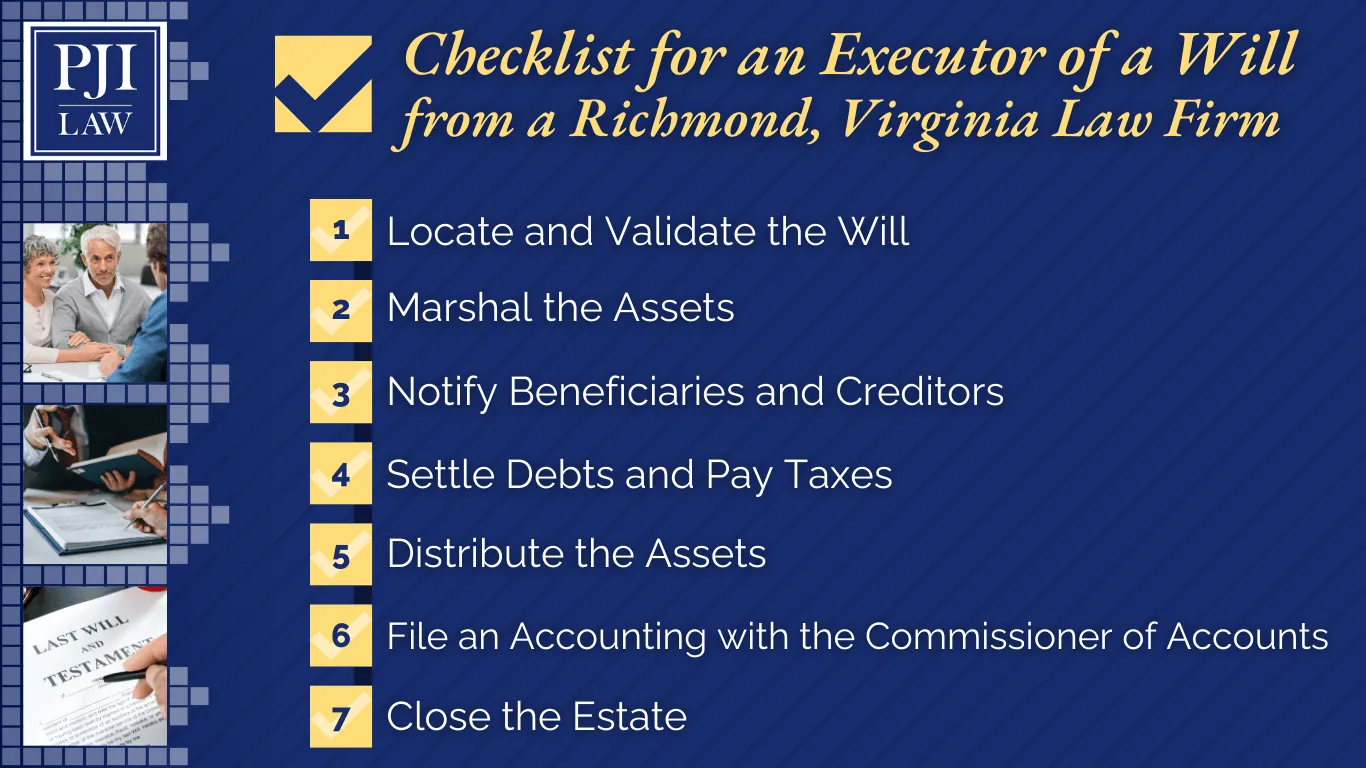
Frequently Asked Questions About Probate & Estate Planning
What is an estate plan, and how does it help avoid probate?
An estate plan is a comprehensive set of legal documents, such as wills, trusts, and power of attorney documents, designed to manage your assets during life and distribute them according to your wishes after death. Our clients avoid probate for certain assets by incorporating tools like revocable living trusts for a faster and more cost-effective property transfer to heirs and beneficiaries. Comprehensive estate planning reduces the administrative burden on an executor/personal representative and minimizes court involvement.
What are the primary responsibilities of an executor/personal representative in estate administration?
In Virginia, a personal representative has the fiduciary duty to manage the probate estate. Their responsibilities include validating the will, locating and securing assets, settling debts, paying taxes, addressing creditor claims, and distributing assets to beneficiaries. A personal representative must also file accountings with the Commissioner of Accounts to comply with state laws. A skilled probate attorney with extensive experience can help manage the process on your behalf, taking care of every detail and offering peace of mind. 
What should I do if I suspect undue influence in a probate estate?
Undue influence occurs when someone manipulates the deceased into altering their will or estate plan for personal gain, often creating disputes during estate administration. If you believe undue influence has impacted the validity of a will, you should consult a probate attorney immediately. An attorney can help investigate your claim, determine sufficient evidence, and guide you through potential litigation to protect the estate’s integrity.
What steps can I take to avoid probate for my future beneficiaries?
Several estate planning strategies are available to help you and your beneficiaries avoid probate, including setting up revocable living trusts, adding transfer-on-death (TOD) or payable-on-death (POD) designations to accounts, and establishing joint tenancy with rights of survivorship for properties. However, sometimes setting up these probate avoidance designations without guidance from a skilled estate planning attorney can cause unintended tax or distribution issues for heirs. Avoiding probate saves time and costs and offers privacy for your loved ones, but only when done correctly and with your entire estate in i. Our Richmond law firm focuses on these practice areas and can provide tailored guidance to create a plan that meets your goals.
How can PJI Law assist with estate administration and disputes?
PJI Law's practice areas include estate planning, business succession planning, deed preparation, medical powers of attorney documents, estate administration, and probate to assist personal representatives and families in and around Richmond, Virginia, and throughout the state. Whether you’re managing the probate process, addressing creditor claims, resolving disputes among beneficiaries, or ready to begin your estate planning, our estate planning and probate attorneys provide compassionate, informed guidance every step of the way. We help clients develop comprehensive estate plans and guide them through sensitive estate matters and probate issues. 
Contact PJI Law, Probate & Estate Planning Lawyers in Richmond, Virginia
Regardless of the size of the estate, probate can present significant challenges for personal representatives. Disputes among beneficiaries, challenges to the will, or estates with substantial assets require informed legal counsel to prevent fiduciary litigation and accusations of financial exploitation, and fulfill all responsibilities legally.
Have you been searching for an “estate administration lawyer,” “probate attorney near me,” or “probate lawyers in Richmond, VA?”
A knowledgeable probate lawyer from PJI Law can guide you through the process, complying with Virginia law and minimizing the risk of legal conflicts. Our law firm provides personalized service and attention for Virginia personal representatives, guiding them through every stage of probate, from marshaling assets to filing accountings and handling disputes.
Whether you need help preparing court filings, managing creditor concerns, or resolving disputes with heirs, our law firm is ready to protect your interests and honor your loved one’s legacy. Contact us at (804) 653-3450 or complete our online form to schedule a consultation to discover how we can help you handle your duties confidently and carefully.
Copyright © 2025. PJI Law, PLC. All rights reserved.
Copyright © 2026. PJI Law, PLC. All rights reserved.
The information in this blog post (“post”) is provided for general informational purposes only and may not reflect the current law in your jurisdiction. No information in this post should be construed as legal advice from the individual author or the law firm, nor is it intended to be a substitute for legal counsel on any subject matter. No reader of this post should act or refrain from acting based on any information included in or accessible through this post without seeking the appropriate legal or other professional advice on the particular facts and circumstances at issue from a lawyer licensed in the recipient’s state, country, or other appropriate licensing jurisdiction.
3900 Jermantown Road, 2nd Floor
Fairfax, VA 22030
(703) 546-9674
https://www.pjilaw.com
Request A Complimentary Call From Our Team
Provide your details, and we’ll reach out promptly to assist you.