
You make a deal. Maybe it's a quick conversation, a handshake, or a promise between you and another party. At the time, it felt clear. You both agree on what needs to happen. Then something changes. The other party doesn't follow through, and now you're left asking what that agreement actually means under Virginia law.
You may be wondering whether verbal agreements hold any weight or if you needed a written contract from the start. The answer isn't always as simple as people think. In many situations, a handshake deal can form a legally binding agreement, but when a dispute arises, the details and the proof start to matter a great deal.
At a Glance

- Why written contracts are far easier to enforce than handshake deals
- When a verbal agreement is still legally binding in Virginia
- How contract disputes are evaluated without a written record
- When Virginia law requires a contract to be in writing
- Why putting it in writing is the smarter choice, even when not required
- What happens when one party fails to perform
- How PJI Law, PLC can help protect your interests
Handshake Deal vs. Written Contract: Key Differences
The biggest practical difference between a handshake deal and a written contract isn't whether it can be enforced. It's how hard you'll have to work to prove what you agreed to.
A written contract gives you a clear record of the terms from day one. Payment amounts, deadlines, and obligations are documented and signed. When a dispute arises, a written contract provides an objective baseline. With an oral contract, you are often left with a story, and the other party may have a different one.
That gap is where most handshake deals fall apart. Not because the agreement wasn't real, but because two people who shook hands in good faith often walk away with different memories of what was said. A written agreement closes that gap before it has a chance to open. 
Are Verbal Agreements Legally Binding in Virginia?
Yes, verbal agreements are legally binding in Virginia, provided the required elements of a contract are present. A handshake deal is simply an informal way of describing an oral contract: an agreement made through spoken words rather than a signed document. These agreements may be enforceable if the parties involved reach a clear understanding and intend to be bound by it.
However, when a contract dispute arises, the first question is whether a valid agreement exists that can be enforced. Regardless of the form, the strength of your position depends on whether you can show that you have met all Virginia contract law requirements. These requirements consist of six fundamental elements that form the foundation of a binding agreement:
- Offer: One party makes a clear proposal to provide goods, services, or payment.
- Acceptance: The other party agrees to the terms as offered, without making significant changes.
- Consideration: Each party exchanges something of value, whether money, goods, services, or a binding promise.
- Mutual Assent: Both parties understand and agree to the terms, a genuine meeting of the minds.
- Capacity: Each party must be of legal age and sound mind to enter into a binding agreement.
- Legality: The subject matter must be lawful. A contract to perform illegal activities cannot be enforced.
These elements come from established Virginia case law and general contract principles. Virginia law uses an objective standard to decide if a contract exists, meaning the focus is on outward actions such as emails, text messages, or payment records, rather than what a party might have been thinking privately at the time.
How Contract Disputes Are Evaluated
Whether a contract dispute is resolved through negotiation or a formal claim, the focus remains on the available evidence to determine whether a valid agreement existed and whether a breach occurred. This includes reviewing written communications, payment records, and witness testimony. The process evaluates whether the parties acted in good faith and whether the agreement's terms can be proven.
Without a written record, the resolution often depends on conflicting accounts from the parties involved. That makes it more difficult to determine what each party promised, which is exactly why the form of your agreement can become the deciding factor in reaching a resolution. It doesn't matter whether you shook hands or signed a document. Virginia law applies the same six-part test to any agreement. 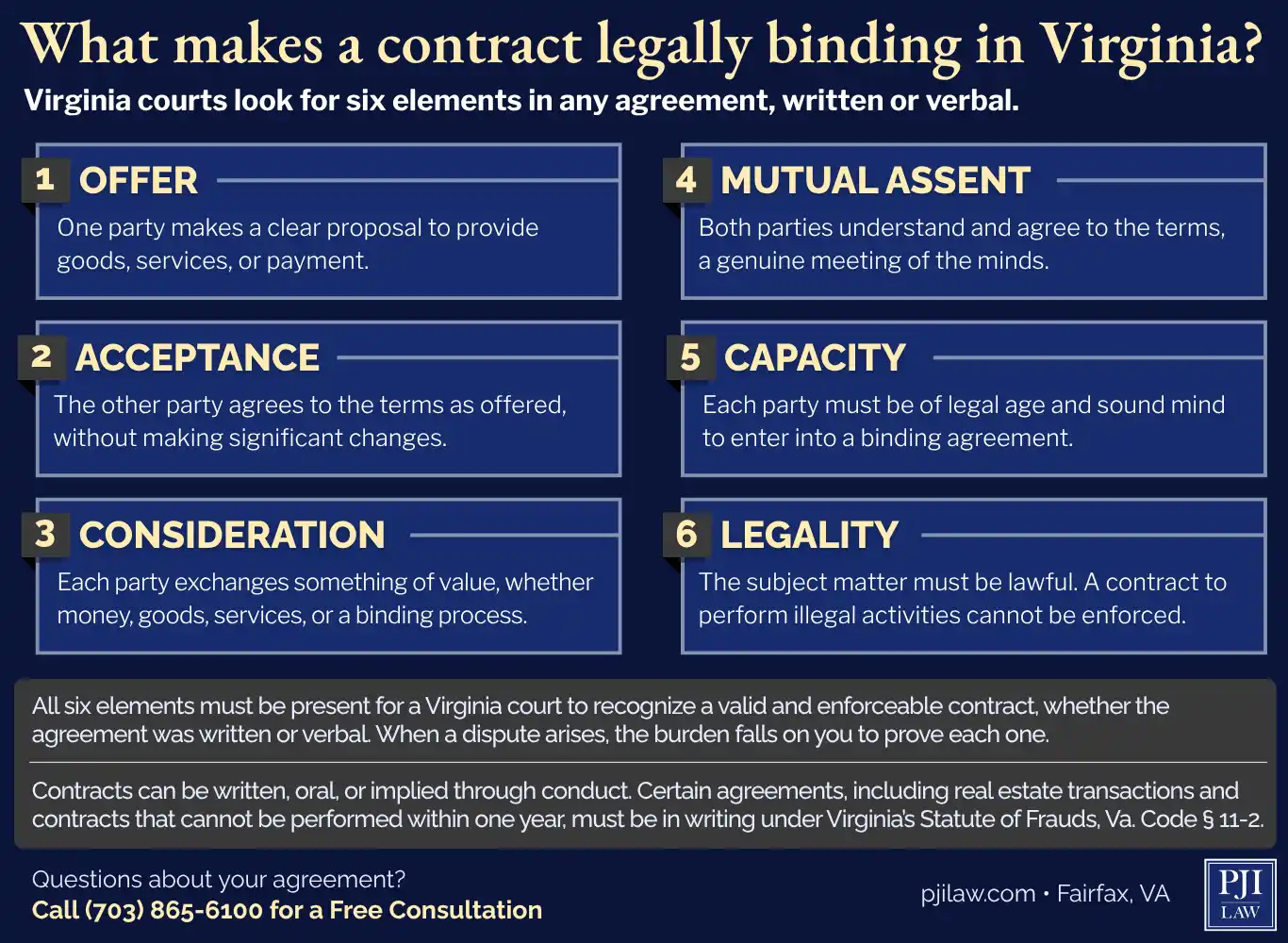
When Virginia Law Requires a Written Contract
Even though some verbal agreements are enforceable, Virginia law requires certain contracts to be in writing under the Statute of Frauds (Va. Code § 11-2).
Under Va. Code § 11-2, agreements must be in writing in situations such as contracts for the sale of real estate, agreements that cannot be performed within one year, promises to pay the debt of another party, and certain business transactions involving significant obligations.
For the sale of goods, Virginia has adopted the Uniform Commercial Code. Under Va. Code § 8.2-201, a contract for the sale of goods valued at $500 or more generally must be in writing to be enforceable. In these circumstances, relying on verbal agreements can create serious legal issues if one party fails to perform. 
Why a Written Contract Is Almost Always the Smarter Choice
If you're entering into a business agreement, putting the terms in writing protects your interests and reduces the risk of future disputes. This is particularly true for service contracts, purchase agreements, agreements involving ongoing obligations, and business relationships involving money or performance over time. A written agreement allows both parties to clearly understand their responsibilities from day one. It also gives you a reliable path to resolve disputes if something goes wrong down the road. Even when Virginia law doesn't require it, a written agreement is almost always the wiser choice. If you're unsure whether your agreement protects you, speaking with a contract lawyer in Virginia can help you identify gaps before they turn into disputes. 
When one party fails to perform, it may constitute a breach of contract. Common examples include a party failing to pay for services, a party not delivering promised goods, or a party refusing to complete agreed-upon work. When a breaching party fails to perform, the other party may file a claim to recover damages. If you're dealing with a breach, you may be able to file a lawsuit in a Virginia court, seek compensation for lost money, or request enforcement of the agreement. Virginia law generally provides a five-year statute of limitations for written contracts under Va. Code § 8.01-246(2) and a three-year period for certain oral agreements under Va. Code § 8.01-246(4). Because these time limits typically begin to run from the date the breach occurs rather than the date you formed the agreement, acting promptly is critical to protecting your rights.
What to Expect When You Work with PJI Law, PLC
Whether you need a contract drafted, an existing agreement reviewed, or legal representation in a dispute, PJI Law, PLC works with clients across Northern Virginia to protect what they've built.
When drafting agreements, our contract lawyers in Virginia can prepare contracts that reflect your goals, define obligations clearly, and include provisions such as confidentiality clauses and liquidated damages where appropriate. If you already have an agreement in place, a lawyer can review the terms and identify potential risks before they become real problems. And if a dispute has already arisen, PJI Law can evaluate your claim, gather evidence, negotiate a resolution, and represent you in litigation or arbitration if it comes to that. 
Frequently Asked Questions
Q: Are verbal agreements legally binding in Virginia?
A: Yes, verbal agreements can be legally binding if the required elements of a contract are present. However, without a written record, proving exactly what was agreed to becomes much harder.
Q: What makes a contract legally binding?
A: A contract becomes legally binding in Virginia when it includes an offer, acceptance, consideration, mutual assent, capacity, and legality.
Q: When is a written contract required in Virginia?
A: Virginia law requires certain agreements to be in writing under the Statute of Frauds, including real estate transactions and contracts that cannot be performed within one year.
Q: Can you sue over a handshake deal?
A: Yes, you can file a lawsuit based on a verbal agreement, but you must prove the agreement's terms and show that a breach occurred.
Q: What evidence can support a contract claim?
A: Evidence may include emails, text messages, payment records, witness testimony, and actions taken by the parties.
Get Clear, Enforceable Contracts That Protect Your Interests
A handshake deal might feel like enough at the start of a business relationship, but a clearly drafted written contract is the most effective way to protect your interests. Whether you’re entering a new deal or facing a dispute over an existing verbal or written agreement, the right legal strategy can protect your assets and your reputation. At PJI Law, PLC, our legal team helps clients across Northern Virginia with each stage of the contract process. We create agreements that reflect your specific goals and define obligations clearly while also analyzing existing agreements to identify risks before they become legal problems. If a party fails to perform, we represent our clients in negotiations and litigation to reach a resolution. Our contract lawyers in Virginia understand the local courts and how Virginia contract law applies to both oral and written agreements. We’ll work closely with you to explain your options and represent you with professionalism at each stage of the process.
If you want to move forward with confidence and protect your interests, call (703) 865-6100 or contact us online to schedule your complimentary consultation today.
At PJI Law, you’ll receive white-glove service and personal attention from a team that treats you like family.
Copyright © 2026. PJI Law, PLC. All rights reserved.
Copyright © 2026. PJI Law, PLC. All rights reserved.
The information in this blog post (“post”) is provided for general informational purposes only and may not reflect the current law in your jurisdiction. No information in this post should be construed as legal advice from the individual author or the law firm, nor is it intended to be a substitute for legal counsel on any subject matter. No reader of this post should act or refrain from acting based on any information included in or accessible through this post without seeking the appropriate legal or other professional advice on the particular facts and circumstances at issue from a lawyer licensed in the recipient’s state, country, or other appropriate licensing jurisdiction.
3900 Jermantown Road, 2nd Floor
Fairfax, VA 22030
(703) 546-9674
https://www.pjilaw.com
Request A Complimentary Call From Our Team
Provide your details, and we’ll reach out promptly to assist you.